
Eudonia spenceri
Munroe, 1972
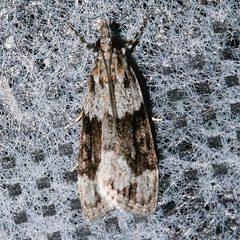
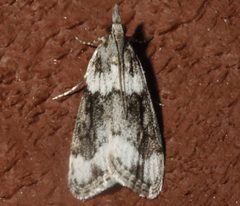
Eudonia spenceri is a small crambid described by Eugene G. Munroe in 1972. The is distributed across western North America from California and Arizona northward to Montana and British Columbia. have a forewing length of 8–9 mm and are active from April through September. The species belongs to the Scopariinae, a group of small moths often associated with moist or riparian .
Pronunciation
How to pronounce Eudonia spenceri: /juːˈdoʊniə ˈspɛnsəri/
These audio files are automatically generated. While they are not always 100% accurate, they are a good starting point.
Identification
The small forewing length (8–9 mm) distinguishes Eudonia spenceri from larger crambid . Within the Eudonia, identification to level requires examination of genitalia or detailed wing pattern analysis; available sources do not provide specific diagnostic characters separating this species from . The geographic range (western North America from California/Arizona to Montana/British Columbia) may help narrow possibilities.
Images
Appearance
Small with forewings 8–9 mm in length. As a member of Scopariinae, likely exhibit the typical crambid resting posture with wings folded tent-like over the body. Specific coloration and pattern details are not documented in available sources.
Habitat
Specific associations are not documented. Based on the distribution across diverse western North American biomes including montane regions and the known of related Scopariinae, the likely occupies moist or mesic environments.
Distribution
Western North America: recorded from California and Arizona north to Montana and British Columbia. The latitudinal range spans approximately 32°N to 49°N.
Seasonality
active from April to September, indicating a spring-to-fall period with likely peak activity during summer months.
Similar Taxa
- Other Eudonia speciesCongeneric share similar small size and general ; definitive identification requires detailed examination of genitalia or wing venation patterns not specified in available sources.
- Other ScopariinaeMembers of this are uniformly small with similar body plans; Eudonia spenceri is distinguished by its specific geographic distribution and the 8–9 mm forewing length measurement.
More Details
Taxonomic History
Described by Canadian lepidopterist Eugene G. Munroe in 1972. Munroe was a in Pyraloidea and made substantial contributions to the classification of North American crambid .
Collection Records
Based on iNaturalist data, the has been documented in at least 301 observations, suggesting it is not rare within its range, though it may be undercollected due to its small size.