
Scopariinae
Moss-eating Crambid Snout Moths
Genus Guides
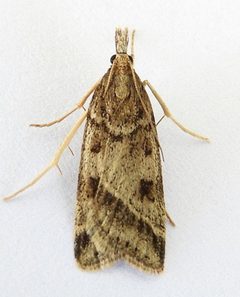
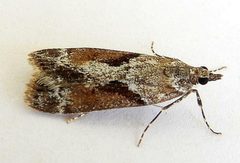
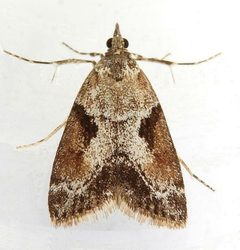
4Scopariinae is a of Crambidae containing approximately 577 described . The subfamily has been recovered as monophyletic in molecular phylogenetic analyses. Larvae feed predominantly on Bryophyta (mosses and liverworts), distinguishing them ecologically from the related Crambinae which feed primarily on Poales. The subfamily has a worldwide distribution with particular diversity in Asia.
Pronunciation
How to pronounce Scopariinae: /skoʊˈpærɪɪni/
These audio files are automatically generated. While they are not always 100% accurate, they are a good starting point.
Identification
Scopariinae can be distinguished from Crambinae by larval plant association: Scopariinae larvae feed on Bryophyta while Crambinae larvae feed predominantly on Poales. wing venation, tympanal organ structure, and genitalia provide additional diagnostic characters at the tribal and generic levels. The includes the Scoparia, Eudonia, Micraglossa, and Helenoscoparia, among others.
Images
Habitat
occur in diverse including laurel forests, oreotropic forests, and other environments supporting moss and liverwort growth. The Micraglossa is specifically associated with laurel and oreotropic forests in Asia. The northern distributional limit of at least some species corresponds to the -10°C mean minimum temperature isotherm of the coldest month.
Distribution
Worldwide distribution with documented occurrence in Asia (China, Japan, India, Thailand, Vietnam, Nepal, Pakistan, Taiwan, Iran), Europe, St Helena Island, and other regions. The Micraglossa approaches its northernmost occurrence in China.
Diet
Larvae feed predominantly on Bryophyta (mosses and liverworts). This distinguishes Scopariinae from the related Crambinae, whose larvae feed primarily on Poales.
Host Associations
- Bryophyta - larval mosses and liverworts
Behavior
The derived, nonadhesive -dropping has been observed in the related Crambinae and is associated with the use of Pooideae as plants; whether this behavior occurs in Scopariinae requires confirmation.
Ecological Role
Larvae function as primary consumers of mosses and liverworts in forest .
Similar Taxa
More Details
Tribal classification
The includes multiple tribes; the study by Leger et al. (2019) established a revised tribal classification based on molecular and morphological data, resolving several synonymies including Caradjaina and Cholius with Scoparia, and Dasyscopa, Dipleurinodes, and Eudipleurina with Eudonia.
Phylogenetic position
Molecular phylogenetic analyses based on five nuclear genes and one mitochondrial gene recover Scopariinae as monophyletic, though its relationships to other crambid remain ambiguous.
Sources and further reading
- BugGuide
- iNaturalist taxon
- NCBI Taxonomy
- Catalogue of Life
- Description of the larva of Helenoscoparia nigritalis (Walker, 1855) (Pyraloidea: Crambidae: Scopariinae)
- Taxonomic revision of the genus Eudonia Billberg, 1820 from China (Lepidoptera: Crambidae: Scopariinae)
- Phylogeny, character evolution and tribal classification in Crambinae and Scopariinae (Lepidoptera, Crambidae)
- A review of the genus Syrianarpia Leraut (Crambidae: Scopariinae) with description of S. elburzalis sp. n. from Iran
- Taxonomic revision and biogeography of Micraglossa Warren, 1891 from laurel forests in China (Insecta: Lepidoptera: Pyraloidea: Crambidae: Scopariinae)