
Eudonia
Billberg, 1820
Species Guides
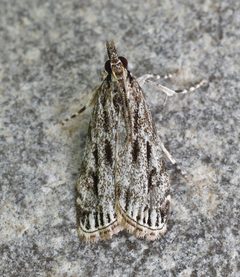
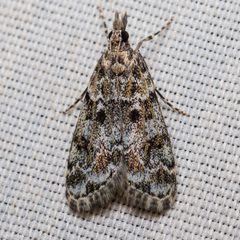
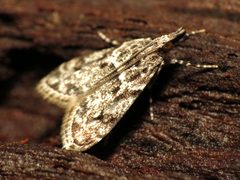
13Eudonia is a large of grass moths (Crambidae: Scopariinae) comprising roughly 250 with a distribution across all continents except extreme environments. The genus was established in the early 19th century but many species were long retained in the related genus Scoparia. Species are generally small, inconspicuous with characteristic genital that distinguishes the genus from close relatives. New species continue to be described regularly, particularly from underexplored regions.
Pronunciation
How to pronounce Eudonia: /juːˈdoʊniə/
These audio files are automatically generated. While they are not always 100% accurate, they are a good starting point.
Identification
Distinguished from the related Scoparia and other Scopariinae by characteristic genital : males possess a simple (nondescript rod-shaped), a clasper's harpe lacking unusual features, and a vesica bearing a small disc with grainy surface; females have a kinked ductus bursae at the junction of membranous and sclerotized portions, with a heavily sclerotized triangle bearing small teeth half-hidden in the kink. Externally, labial palps are elongated and project straight forward, appearing pointed and beak-like. Forewing venation lacks the loop formed by 1a/1b present in some related genera.
Images
Habitat
Occurs across diverse terrestrial from sea level to high altitudes (recorded to 433 m on Macquarie Island, with higher elevations likely elsewhere); absent from deserts, high mountains above treeline/glaciated areas, and polar ice sheets. Habitats include mire, short grassland, herbfield, feldmark, rocky moorland, and moss-dominated sites.
Distribution
distribution across all continents except Antarctica; present in Europe (including Fennoscandia, Britain, Denmark, Norway, Sweden), Asia (China with 25+ , Taiwan, Japan, Afghanistan, India), North America (Vermont, US), Oceania (New Zealand, Hawaiian Islands, Austral Islands, Marquesas, subantarctic Macquarie Island), and presumably Africa and South America given the global range. Polynesian island radiations demonstrate capacity for over-water .
Diet
Larvae feed primarily on mosses, specifically subclasses Bryidae and Dicranidae; some also consume lichens. Specific moss recorded include Hypnum cupressiforme, Dicranum scoparium, Bryum capillare, and Grimmia pulvinata. In a few cases, other plants have been recorded: Colobanthus pearlworts and Olearia daisy-bushes.
Life Cycle
Larvae feed within silken tubes constructed on mosses. of at least some fly from late May to mid-September in temperate regions.
Similar Taxa
- ScopariaType of Scopariinae and close relative; historically many Eudonia were placed here; distinguished by genital , particularly the characteristic simple and vesica disc in male Eudonia and the kinked ductus bursae with sclerotized triangle in females
- Eudonia truncicolellaDifficult to separate from E. murana and Scoparia ambigualis even with dissection; identification requires examination of genitalia
- Eudonia muranaDifficult to separate from E. truncicolella and Scoparia ambigualis even with dissection
Sources and further reading
- BugGuide
- Wikipedia
- GBIF taxonomy match
- iNaturalist taxon
- NCBI Taxonomy
- Catalogue of Life
- Taxonomic revision of the genus Eudonia Billberg, 1820 from China (Lepidoptera: Crambidae: Scopariinae)
- Notes on the biology of Eudonia mawsoni (Lepidoptera:Pyralidae) on subantarctic Macquarie Island
- The genome sequence of the Moorland Grey, Eudonia murana (Curtis, 1827) (Lepidoptera: Crambidae).
- The genome sequence of the Little Grey, Eudonia lacustrata (Panzer, 1804).
- The genome sequence of the Peppered Grey, Eudonia truncicolella (Stainton, 1849).