
Sitochroa palealis
(Denis & Schiffermüller, 1775)
carrot seed moth
Sitochroa palealis, known as the carrot seed , is a crambid moth native to Europe that was first reported in the United States in 2002. The has a wingspan of 26–34 mm and is active during summer months. Its larvae specialize on umbelliferous plants, including cultivated carrot and fennel.
Pronunciation
How to pronounce Sitochroa palealis: //ˌsɪtəˈkrəʊə ˌpæl.iˈælɪs//
These audio files are automatically generated. While they are not always 100% accurate, they are a good starting point.
Identification
Accurate identification requires examination of forewing venation geometry. Geometric morphometry of nine junction landmarks distinguishes S. palealis from similar crambids such as Sitochroa verticalis, Anania hortulata, and Pleuroptya ruralis. Wing scanning and software analysis can achieve 97% in separating these .
Images
Appearance
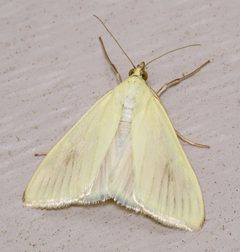
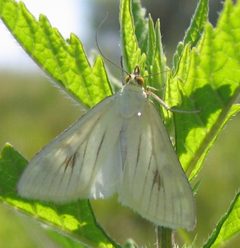
have a wingspan of 26–34 mm. Forewings are yellowish-brown with lateral wavy dark bands. Overall coloration is somewhat nondescript, making visual identification difficult without close examination of wing venation patterns.
Habitat
Found in agricultural and natural settings where plants occur. Larvae develop on umbellifers in fields, gardens, and disturbed areas. frequent with flowering umbelliferous vegetation.
Distribution
Native to Europe, with established across the continent including Belgium. Introduced to North America; first U.S. record in 2002.
Seasonality
fly from June to July, with timing varying by location.
Diet
Larvae feed on Daucus carota (wild and cultivated carrot), Peucedanum oreoselinum, Heracleum , Foeniculum species (including cultivated fennel), and Silaum species. diet not specified in sources.
Host Associations
- Daucus carota - larval food plantincludes cultivated carrots
- Peucedanum oreoselinum - larval food plant
- Heracleum - larval food plant-level association
- Foeniculum - larval food plantincludes cultivated fennel
- Silaum - larval food plant-level association
Life Cycle
Complete . Larval stage feeds internally or externally on umbellifer plants. and occur in early summer. One per year with adults active June–July.
Ecological Role
herbivore on Apiaceae. May act as seed of umbelliferous plants in natural and agricultural .
Human Relevance
Pest of cultivated carrot and fennel crops due to larval seed feeding. Presence in North America since 2002 indicates potential for agricultural impact in introduced range.
Similar Taxa
- Sitochroa verticaliscongeneric with similar wing coloration and markings, co-occurs in agricultural , distinguished by wing venation geometry
- Anania hortulatasympatric crambid with similar nondescript yellowish-brown forewings, distinguished by geometric morphometry of wing landmarks
- Pleuroptya ruralisfound in corn fields and other agricultural settings with similar appearance, requires wing venation analysis for reliable separation
More Details
Identification Technology
Polish researchers developed a semiautomated identification method using geometric morphometry of nine forewing landmarks. This technique allows non- to distinguish S. palealis and related crambids from agricultural pests like the European corn borer with 97% using scanned wing images and specialized software.
Invasion History
First North American record in 2002 represents a recent transatlantic introduction. The mechanism of introduction is unreported, but the ' association with cultivated plants suggests possible transport via agricultural trade.