
Anania funebris
Ström, 1768
White-spotted Sable
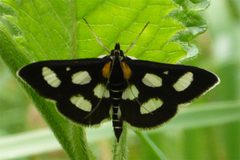
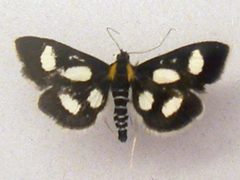
Anania funebris is a day-flying in the Crambidae, commonly known as the white-spotted sable. It is widespread across Europe, northern Asia, and North America. The exhibits a distinctive black-and-white wing pattern and has two recognized separated by geography: A. f. funebris in Eurasia and A. f. glomeralis in North America.
Pronunciation
How to pronounce Anania funebris: /əˈnæniə fjuːˈnɛbrɪs/
These audio files are automatically generated. While they are not always 100% accurate, they are a good starting point.
Identification
Distinguished from similar Crambidae by the combination of black forewings with two prominent round white spots and white-tipped cilia. The separates it from most crambid . Similar Anania hortulata has different wing pattern with more extensive pale markings. Sitochroa verticalis and Pleuroptya ruralis, which co-occur in , have more uniform or differently patterned wings without the distinct paired white spots.
Images
Appearance
Wingspan 20–23 mm. Forewings black with two large round white spots: one before the middle and one in the disc beyond the middle; occasionally a small white dot above the first spot. Cilia white towards tips. Hindwings similarly black with white subdorsal spots but lacking the small white dot present on forewings. Larva ochreous-whitish with deep green line, green subdorsal and lateral lines, whitish-green spiracular line, green dots, and whitish-brown .
Habitat
Found in meadows, grasslands, and open where larval plants grow. Associated with areas supporting goldenrod and other Asteraceae. frequent flowers for nectar.
Distribution
Widespread in Europe, northern Asia (Siberia, northern Far East), and North America. Two : A. f. funebris occurs in Eurasia; A. f. glomeralis occurs in North America.
Seasonality
fly during the day from late April to August, with peak activity in June and July.
Diet
Larvae feed on leaves of goldenrod (Solidago), primarily Solidago virgaurea. Occasionally feeds on dyer's greenweed (Genista tinctoria). feed on nectar from flowers.
Host Associations
- Solidago virgaurea - larval food plantprimary
- Solidago - larval food plant-level feeding
- Genista tinctoria - larval food plantoccasional
Life Cycle
Complete with , larval, pupal, and stages. Larvae feed on plant leaves. stage not explicitly documented in sources. Adults emerge in spring and fly through summer.
Behavior
activity is notable for a crambid . have a tendency to quickly hide behind leaves when disturbed. Adults visit flowers for nectar.
Ecological Role
Larval herbivore on goldenrod; . Part of meadow and grassland , serving as prey for birds and other .
Human Relevance
Not a significant agricultural pest. May be encountered by naturalists and entomologists in field surveys. The North American A. f. glomeralis has been used in studies comparing wing venation patterns for identification techniques.
Similar Taxa
- Anania hortulataSimilar size and but has more extensive pale wing markings rather than distinct round white spots on black background
- Sitochroa verticalisCo-occurs in meadows and has similar coloration, but wing pattern differs and is
- Pleuroptya ruralisFound in similar with somewhat similar wing coloration, but pattern is more uniform without paired white spots
More Details
Subspecies
Two recognized: Anania funebris funebris (Ström, 1768) in Eurasia and Anania funebris glomeralis (Walker, 1859) in North America.
Research significance
Included in geometric morphometry studies for automated identification of Crambidae , helping distinguish it from agricultural pest like the European corn borer.
Sources and further reading
- BugGuide
- Wikipedia
- GBIF taxonomy match
- iNaturalist taxon
- NCBI Taxonomy
- Catalogue of Life
- Meloidae Holdings | Entomology Research Museum
- Behold: the Banded Alder Borer | Bug Squad
- What's That Bug? | Bug Squad
- Look but do not touch: Blister beetles, Epicauta pensylvanica and E. funebris — Bug of the Week
- New Technique May Help Farmers Identify the European Corn Borer
- Uncategorized | Blog - Part 29