
Euchromius ocellea
Haworth, 1811
Belted Grass-veneer, necklace veneer
Euchromius ocellea is a migratory in the Crambidae, first described by Haworth in 1811. It is widespread in tropical and subtropical regions, with occasional rare to temperate areas such as the UK and Netherlands. The is notable for its wing patterning and its larval association with grass crops including maize and sorghum.
Pronunciation
How to pronounce Euchromius ocellea: //juːˈkroʊmiːəs oʊˈsɛliə//
These audio files are automatically generated. While they are not always 100% accurate, they are a good starting point.
Identification
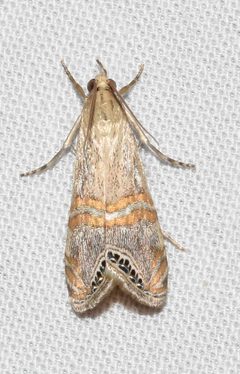
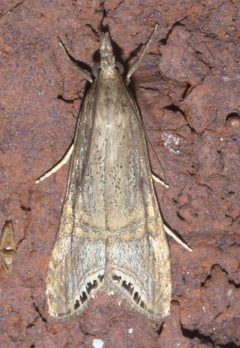
Distinguished from the similar and much rarer Euchromius californicalis by wing pattern details and geographic context. The combination of two medial forewing bands, terminal black dots with adjacent golden metallic spots, and silver streaking on the forewings is characteristic. Males can be identified by the semi-transparent patch on the basal side of the forewing . The white body with amber pinacula separates larvae from many other crambid larvae.
Images
Appearance
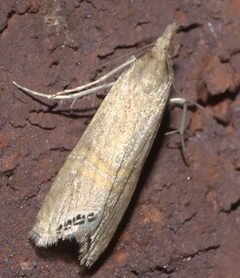
have a wingspan of 13–27 mm. Forewings are creamy white with dense ochreous to dark brown scaling, featuring two medial bands, a subterminal line, a white patch near the terminal area, and black dots in the terminal area. Additional markings include fine silver streaking, golden metallic spots near the black terminal dots, and in males, a semi-transparent patch on the basal side of the . Some specimens show a yellowish spot in the area. The fringe is white with two brown or black lines. Larvae have a white body with amber pinacula and pale amber , reaching 18–20 mm in length.
Habitat
Associated with grassland and agricultural environments where plants occur. Larval includes the root zones of cultivated grasses. are attracted to light and have been documented in urban and suburban settings during blacklight surveys.
Distribution
distribution with core range in tropical and subtropical regions. Documented across Africa with seasonal periods varying by region: southern Africa (October–April), eastern Africa (November–February and June–July), western Africa (November–March). Rare migrant to temperate Europe including the UK and Netherlands. Present in North America including California, where it is common in the Davis area.
Seasonality
activity varies geographically. In southern Africa: October to April. In eastern Africa: bimodal with peaks November–February and June–July. In western Africa: November to March. In temperate regions, occurrence is sporadic and -dependent.
Diet
Larvae feed on maize (Zea mays) and sorghum (Sorghum bicolor), consuming roots and basal plant parts. feeding habits are not documented.
Host Associations
- Zea mays - larval food plantmaize
- Sorghum bicolor - larval food plantsorghum
Life Cycle
Complete with , larval, pupal, and stages. Larvae grow to 18–20 mm. Specific details of site and strategy are not documented.
Behavior
are and attracted to light. The is migratory, capable of long-distance that results in sporadic appearances outside its core tropical range. Larvae are root-feeders, concealed in soil or at the base of plants.
Ecological Role
Larvae function as herbivores on cultivated grasses. In agricultural settings, they may contribute to crop damage, though their overall impact relative to other pests is not well quantified. serve as prey for and may contribute to pollination though this is not documented.
Human Relevance
Considered a potential agricultural pest due to larval feeding on maize and sorghum roots. The was first described from Europe and may have been introduced to some parts of its current range through human-mediated transport of agricultural products. are frequently encountered in citizen science monitoring programs and blacklight surveys.
Similar Taxa
- Euchromius californicalisVery similar congeneric that is much rarer; distinguished by subtle wing pattern differences and geographic distribution
More Details
Taxonomic note
The has been classified under Hodges number 5454 in North American systems. First described by Adrian Hardy Haworth in 1811, making it one of the earlier described crambid species.
Observation frequency
Despite being called a 'rare migrant' in some parts of its range, the can be abundant locally; at one blacklighting event in Davis, California, six individuals were captured compared to single specimens of other species.