
Euchromius
Guenée, 1845
Species Guides
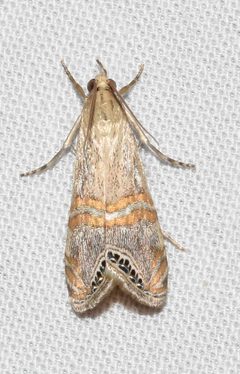
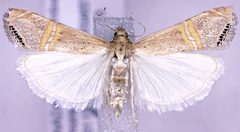
2- Euchromius californicalis(California grass-veneer)
- Euchromius ocellea(Belted Grass-veneer)
A of grass-veneer moths in the Crambidae, established by Guenée in 1845. are distributed across all continents except South-East Asian islands, with highest diversity in the Palaearctic region, Africa, and the Near and Middle East. Several species are migratory and can establish temporary outside their core ranges. Larvae are primarily , feeding on dead plant material near the base of grasses and other plants.
Pronunciation
How to pronounce Euchromius: //juːˈkrəʊmiəs//
These audio files are automatically generated. While they are not always 100% accurate, they are a good starting point.
Identification
are small to medium-sized crambid with narrow, elongated wings. Forewings typically display longitudinal stripes or banded patterns; the "Belted Grass-Veneer" for E. ocellea refers to such patterning. Accurate identification often requires examination of genitalia: males possess thorns on the gnathos with subterminal insertion of the ductus ejaculatorius; females show variation in ductus bursae length, bursa copulatrix shape, and presence/absence of signa.
Images
Habitat
Dry to fresh, warm environments including xerothermous steppes, colline and montane grasslands, rock steppes, slope steppes, degraded marshes, semi-natural woodland-grassland mosaics, hay meadows, acid grasslands and heaths, open rock grasslands, and oak woodlands. Elevation range from sea level to 1000–1200 m; in Hungary, E. ocelleus occurs at 75–400 m and E. bellus at 100–690 m.
Distribution
Widespread across Europe (12 ), Africa, the Near and Middle East, North and South America, and Australia. Not recorded from South-East Asian islands. In Europe, present in Hungary, Denmark, Norway, and Sweden among other countries. E. ocelleus is a widespread tropical, subtropical and holomediterranean species that immigrates northward; E. bellus occurs in Hungary, the Balkans, Eastern Europe, the Middle East, and Central Asia.
Seasonality
periods vary by . E. ocelleus: August to mid-October (). E. bellus: June to end of August. Several species fly at dusk and are attracted to light.
Diet
Larvae are detritophagous, feeding on dried vegetal detritus and dead leaves accumulated near the base of plants. Documented food plants include Asteraceae (Hieracium, Picris) and Dipsacaceae (Scabiosa). Larvae occasionally attack living plants and flower-; E. ocelleus has been recorded accidentally feeding on corn and milo maize roots in stored produce. do not feed.
Life Cycle
. Larval development: E. ocelleus from July to early August; E. bellus from August to June of the following year. occurs in plant remains. E. ocelleus likely hibernates as , though this remains unconfirmed. may occur through transportation of pupae with plant material.
Behavior
are attracted to light and several fly at dusk. E. ocelleus exhibits migratory , capable of establishing temporary beyond its main distribution range.
Ecological Role
Larvae function as , contributing to decomposition of dead plant material. Accidental herbivory on living plants and flower occurs but is not the primary feeding mode.
Human Relevance
E. ocelleus is a common in agricultural areas such as Davis, California, and occasionally appears in stored produce facilities. Not considered a significant agricultural pest despite accidental feeding records.
Similar Taxa
- Euchromius californicalisVery similar external appearance to E. ocelleus; reliable separation requires examination of genitalia or wing pattern details. E. californicalis is much rarer where both occur.