
Chrysoteuchia
Hübner, 1825
sod webworms, cranberry girdlers
Species Guides
1- Chrysoteuchia topiarius(Topiary Grass-veneer)
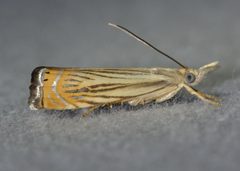
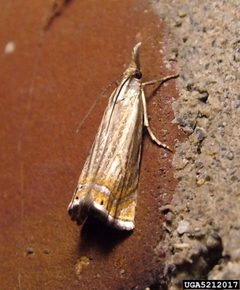
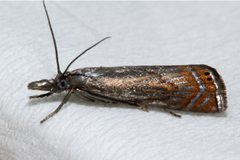
Chrysoteuchia is a of Crambidae containing approximately 36 worldwide, with exceptional diversity in China (33 species). The genus exhibits a Palearctic, Sino-Japanese, and Oriental distribution pattern. Species are strongly associated with humid to semi-humid environments and show cold with humidity-dependent distribution patterns. The cranberry girdler (C. topiarius) is a notable pest of cool-season turfgrasses, cranberries, and fir in North America.
Pronunciation
How to pronounce Chrysoteuchia: //ˌkɹɪsoʊˈtuːki.ə//
These audio files are automatically generated. While they are not always 100% accurate, they are a good starting point.
Identification
-level identification requires examination of genitalia ; within Chrysoteuchia are distinguished by male genitalia features including uncus shape, gnathos structure, and valva configuration. are small to medium-sized crambid with relatively nondescript forewing patterns typically in brown, tan, or gray tones. Accurate species identification is challenging without dissection and reference to original descriptions.
Images
Habitat
Humid to semi-humid monsoon regions; suitable areas characterized by 310–867 mm precipitation in the warmest quarter. In China, highest suitability occurs in southeastern regions. Alpine exist: C. landryi collected at 3415 m elevation in alpine meadow, shrub, and conifer vegetation on south slopes with persistent snow cover.
Distribution
Primary diversity center in China with 33 of 36 known ; peaks at 25°N–30°N latitude (22 species), declining northward. Notable high-diversity localities include Dailing (Heilongjiang) and Wuyishan (Fujian) with 7 species each. Palearctic, Sino-Japanese, and Oriental realms globally. C. topiarius established in North America as introduced pest. C. landryi currently known only from Galongla Snow Mountain, Mêdog County, Tibet. GBIF records indicate presence in Denmark, Norway, Sweden, and Vermont (USA).
Seasonality
C. landryi observed in in late July. C. topiarius larvae active in cool-season turfgrass systems with damage occurring during growing season.
Diet
C. topiarius larvae feed on roots and crowns of cool-season turfgrasses (tall fescue, ryegrass, fine fescue), cranberry (Vaccinium macrocarpon), and fir (Abies).
Host Associations
- tall fescue - herbivorelarval ; root and crown feeder
- perennial ryegrass - herbivorelarval
- fine fescue - herbivorelarval
- cranberry - herbivoreVaccinium macrocarpon; larval
- fir - herbivoreAbies; larval
Life Cycle
Complete with , larva, pupa, and stages. C. topiarius larvae are subterranean, feeding on roots and crowns of plants. occurs in soil.
Behavior
attracted to mercury-vapour light at night. Males exhibit specific behavioral responses to female-produced components; optimal attraction requires specific dosage and ratio of components. C. topiarius larvae exhibit subterranean feeding , requiring irrigation or rainfall for effective incorporation in management programs.
Human Relevance
C. topiarius (cranberry girdler/sod webworm) is a significant pest of cool-season grass seed crops in Oregon and turfgrasses in North America, causing substantial economic damage. Chemical control options are limited and require moisture for incorporation. Endophyte-mediated resistance in tall fescue cultivars offers sustainable management alternative; increased larval mortality correlated with peramine and ergot alkaloid concentrations. Potential use as bioindicators for global warming monitoring due to cold and humidity-dependent distribution.
Similar Taxa
- other Crambinae generasimilar general ; distinguished by genitalia structure and molecular data
- Pediasiaoverlapping distribution and ; requires genitalia examination for separation
Sources and further reading
- BugGuide
- Wikipedia
- GBIF taxonomy match
- iNaturalist taxon
- NCBI Taxonomy
- Catalogue of Life
- Four new species of the genus Chrysoteuchia Hübner (Lepidoptera: Crambidae: Crambinae) from China
- The geographical distribution patterns of Chrysoteuchia Hübner in China and description of a new species (Lepidoptera, Crambidae)
- Effect of Dosage and Ratio of Sex Pheromone Components on Behavior of Chrysoteuchia topiaria (Zeller) (Lepidoptera: Pyralidae)
- Figure 2 from: Jie L-L, Yang J-B, Li W-C (2019) The geographical distribution patterns of Chrysoteuchia Hübner in China and description of a new species (Lepidoptera, Crambidae). ZooKeys 853: 109-118. https://doi.org/10.3897/zookeys.853.34149
- Figure 1 from: Jie L-L, Yang J-B, Li W-C (2019) The geographical distribution patterns of Chrysoteuchia Hübner in China and description of a new species (Lepidoptera, Crambidae). ZooKeys 853: 109-118. https://doi.org/10.3897/zookeys.853.34149
- Supplementary material 2 from: Jie L-L, Yang J-B, Li W-C (2019) The geographical distribution patterns of Chrysoteuchia Hübner in China and description of a new species (Lepidoptera, Crambidae). ZooKeys 853: 109-118. https://doi.org/10.3897/zookeys.853.34149
- Supplementary material 1 from: Jie L-L, Yang J-B, Li W-C (2019) The geographical distribution patterns of Chrysoteuchia Hübner in China and description of a new species (Lepidoptera, Crambidae). ZooKeys 853: 109-118. https://doi.org/10.3897/zookeys.853.34149
- Figures 8-10 from: Jie L-L, Yang J-B, Li W-C (2019) The geographical distribution patterns of Chrysoteuchia Hübner in China and description of a new species (Lepidoptera, Crambidae). ZooKeys 853: 109-118. https://doi.org/10.3897/zookeys.853.34149
- Response of sod webworm Chrysoteuchia topiaria Zeller (Lepidoptera: Crambidae) to endophyte infection and mycotoxin profiles of cool‐season turfgrass species grown for seed in Oregon
- Figures 3-7 from: Jie L-L, Yang J-B, Li W-C (2019) The geographical distribution patterns of Chrysoteuchia Hübner in China and description of a new species (Lepidoptera, Crambidae). ZooKeys 853: 109-118. https://doi.org/10.3897/zookeys.853.34149
- The genome sequence of the garden grass-veneer, Chrysoteuchia culmella (Linnaeus, 1758).