
Hellinsia
Tutt, 1905
Species Guides
27- Hellinsia albilobata(White-lobed Plume Moth)
- Hellinsia angustus
- Hellinsia arion(Long-harped Plume Moth)
- Hellinsia auster(Austere Plume Moth)
- Hellinsia balanotes(Baccharis Borer)
- Hellinsia brucei(Bruce's Plume Moth)
- Hellinsia caudelli(Caudell's Plume Moth)
- Hellinsia chlorias(Chlorias Plume Moth)
- Hellinsia citrites(Citrites Plume Moth)
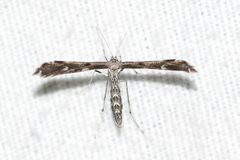
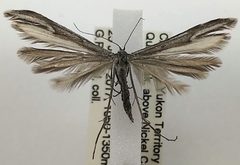
Hellinsia is a of plume moths in the Pterophoridae, established by J.W. Tutt in 1905 and named in honor of entomologist John Hellins. The genus comprises numerous distributed across the Holarctic region, with documented occurrences in North America, Europe, and Asia. Species identification relies heavily on genitalia and wing pattern characteristics. Notable biological findings include the first documented case of ovoviviparity in an Arctic of H. albilobata.
Pronunciation
How to pronounce Hellinsia: /hɛˈlɪn.si.ə/
These audio files are automatically generated. While they are not always 100% accurate, they are a good starting point.
Identification
-level identification within Hellinsia requires examination of male and female genitalia structure; wing pattern alone is insufficient for reliable differentiation. H. albilobata and H. mongolica exhibit overlapping wing pattern variability across their Russian ranges, necessitating genital dissection for confirmation. The can be distinguished from other Oidaematophorini by combinations of wing venation, leg scaling, and abdominal tergite characteristics, though specific diagnostic features vary by species.
Images
Distribution
Documented from Denmark, Norway, Sweden, the United States (including Vermont), and Russia. Within Russia, H. albilobata occurs across various regions including Arctic areas; H. mongolica has been recorded from Kemerovo Oblast and other parts of Russia. The exhibits a Holarctic distribution pattern.
Life Cycle
Ovoviviparity has been observed in Arctic of H. albilobata, representing the first report of this reproductive mode in the . In this condition, are retained within the female body until they hatch, rather than being deposited externally as in typical development.
Similar Taxa
- OidaematophorusBoth belong to tribe Oidaematophorini and share with divided wings; separation requires examination of genitalia and specific wing venation patterns
- PterophorusShares -level characteristics of deeply cleft wings; Hellinsia generally smaller with different abdominal scaling and distinct genitalia structure
More Details
Taxonomic history
The was erected by J.W. Tutt specifically to honor fellow entomologist John Hellins. Recent taxonomic revisions have confirmed synonymies, including H. wrangeliensis (Zagulajev, 1985) as a junior synonym of H. albilobata.
Reproductive biology note
The ovoviviparity observed in Arctic H. albilobata may represent an to extreme environmental conditions, though the ecological significance and of this trait across the remain unstudied.