
Apodemia
C. & R. Felder, 1865
metalmark butterflies
Species Guides
10- Apodemia ares(Ares Metalmark)
- Apodemia duryi(Organ Mountain metalmark)
- Apodemia hepburni(Hepburn's Metalmark)
- Apodemia mejicanus(Mexican Metalmark)
- Apodemia mormo(Mormon Metalmark)
- Apodemia nais(Nais Metalmark)
- Apodemia palmerii(Palmer's Metalmark)
- Apodemia virgulti(Behr's Metalmark)
- Apodemia walkeri(Walker's Metalmark)
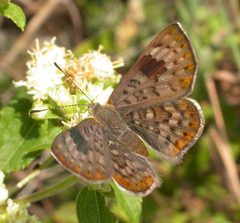
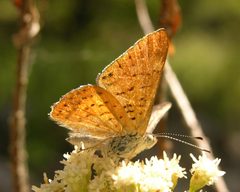
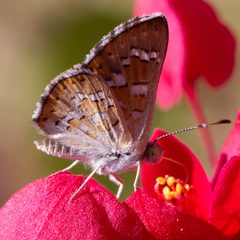
Apodemia is a New World of metalmark butterflies ( Riodinidae) ranging from Canada to Brazil. The genus contains approximately 18 described , including the type species Apodemia mormo (Mormon metalmark). Species-level has undergone revision; Apodemia paucipuncta was transferred to the new genus Hallonympha based on morphological and behavioral characters. Oviposition varies geographically: northern of A. mormo deposit single on soil or rocks, while southern populations lay eggs in groups on plants.
Pronunciation
How to pronounce Apodemia: /ˌæpoʊˈdiːmiə/
These audio files are automatically generated. While they are not always 100% accurate, they are a good starting point.
Identification
As a , Apodemia are metalmark butterflies characterized by small to medium size and often subdued coloration compared to other riodinids. Species identification requires examination of wing pattern elements, genitalia , and geographic distribution. The genus is distinguished from related riodinid genera by male genitalic characters including valva and transtilla structure. A. mormo, the type species, serves as a reference for comparative identification.
Images
Habitat
vary by . A. mormo occurs in grassland environments in northern peripheral , with microhabitat use extending beyond plant distribution. Southern populations are associated with areas supporting Eriogonum pauciflorum (Branched Umbrella-Plant).
Distribution
New World distribution from Canada to Brazil. Documented in Canada (Saskatchewan, Grasslands National Park), throughout the United States southwest, and southward through the Neotropics.
Diet
feed on nectar. Larval diet: A. mormo larvae feed on Eriogonum pauciflorum (Branched Umbrella-Plant).
Host Associations
- Eriogonum pauciflorum - larval plantBranched Umbrella-Plant; used by A. mormo
Life Cycle
Complete with , larva, pupa, and stages. Eggs: deposited singly on soil or rocks in northern A. mormo ; deposited in groups of 2–4 on plant in southern populations. Larval development occurs on host plant. details not documented.
Behavior
Oviposition shows geographic variation within A. mormo. Northern females exhibit atypical substrate use, depositing on non-plant surfaces (soil, rocks) rather than directly on larval plants. This behavioral plasticity in peripheral may represent to environmental constraints.
Similar Taxa
- HallonymphaFormerly included A. paucipuncta; distinguished by early stage and characters including male genitalia structure
- AdelotypaClosely related in tribe Nymphidiini; phylogenetic analysis shows non-monophyly requiring taxonomic revision
- CalephelisAnother riodinid metalmark with overlapping distribution; distinguished by wing pattern and genitalic characters
More Details
Taxonomic History
Apodemia paucipuncta was historically placed in Apodemia (Incertae Sedis, previously tribe Emesini) but cladistic analysis of 72 male characters demonstrated it belongs to a new Hallonympha in tribe Nymphidiini, as sister to Adelotypa eudocia. The genus Apodemia sensu stricto requires further revision to confirm monophyly.
Conservation Note
Northern peripheral of A. mormo in Canada represent range-edge occurrences with documented behavioral divergence; these populations may warrant specific conservation attention due to limited distribution and specificity.
Sources and further reading
- BugGuide
- Wikipedia
- iNaturalist taxon
- NCBI Taxonomy
- Catalogue of Life
- Bug Eric: September 2010
- Bug Eric: (Wild) Butterfly Magic
- Damasias and Thales: stasis and sophia at the term of Solon’s apodemia
- Systematic position of Apodemia paucipuncta (Riodinidae), and a critical evaluation of the nymphidiine transtilla
- First Observations of Mormon Metalmark (<em>Apodemia mormo</em>) Oviposition Behaviour in Canada
- Microhabitat Use in a Northern Peripheral Population ofApodemia mormo: Factors Beyond the Host Plant