
Nathalis iole
Boisduval, 1836
dainty sulphur, dwarf yellow
Nathalis iole, commonly known as the dainty sulphur or dwarf yellow, is the smallest North American pierid . It exhibits remarkable morphological variability, including seasonal wing coloration changes and distinctive structural features that have prompted suggestions it warrants a separate within Pieridae. The occupies diverse open , migrates south for winter survival, and has been documented performing elaborate including a newly described facultative male display .

Pronunciation
How to pronounce Nathalis iole: /ˈnaː.tʰa.lis ˈi.o.le/
These audio files are automatically generated. While they are not always 100% accurate, they are a good starting point.
Identification
Distinguished from similar by elongated forewing shape, smallest size among North American pierids, and presence of black bars on both forewing trailing edge and hindwing leading edge. Male androconial spots present. Barred yellow (Eurema daira) is larger with grayish-white or brownish-red underside lacking seasonal variation. Little yellow (Eurema lisa) is larger, lacks black bars on both wings, and lacks black spots and yellowish-orange patch on forewing underside.
Images
Appearance
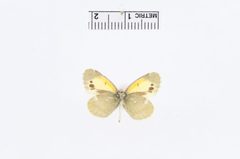
Smallest North American pierid with highly variable appearance. Forewings elongated and distinctive in shape. Upperside yellow with black forewing tip; black bars extend along trailing edge of forewing and leading edge of hindwing. Males possess oval reddish-orange androconial scent patch in each hindwing bar, fading to pale yellow after death. Underside varies seasonally: summer individuals have yellowish hindwings, winter individuals have greenish-gray hindwings. Both forms display black spots near forewing margin and yellowish-orange patch near forewing base. Rare mostly-white known from Homestead.
Habitat
Occupies almost any open space including coastal flats, deserts, fields, roadsides, vacant lots, and waste areas. Typically flies very low to the ground.
Distribution
North America; recorded from Canada (Manitoba, Saskatchewan) through the United States. Migrates south to overwinter, unable to survive cold temperatures.
Seasonality
Active during warmer months; migrates south for winter. Multiple per year. Winter phenotype induced by short day length during larval stage, producing with three times the usual number of dark for enhanced solar heat absorption.
Diet
feed on nectar. Larvae feed on young or emerging leaves of plants.
Host Associations
- Bidens bipinnata - larval Spanish needles
- Bidens - larval Beggar ticks, unspecified
- Dyssodia - larval Dogweed, unspecified
- Stellaria media - larval Common chickweed
- Thelesperma - larval Greenthread, unspecified
Life Cycle
Females lay lemon-yellow or orange-yellow singly on plant leaves; eggs hatch in 4–7 days. Larvae highly variable: dark green, or dark green with bright pinkish-purple stripes; stiff-haired with two pinkish-red bumps above . Green or yellow-green chrysalis covered with yellow-white dots, lacking head projection typical of most pierids. Short day length during larval stage induces winter phenotype with increased dark scaling. Multiple annually; migrates south to overwinter.
Behavior
Males patrol just inches above ground searching for females. Upon female rejection, males perform open-winged display showing bars and androconial spots as last-resort courtship effort. Courtship involves standard approach plus newly described facultative male display. Flies very low to ground.
Similar Taxa
- Eurema dairaBarred yellow is larger with grayish-white or brownish-red underside, lacks seasonal underside color variation
- Eurema lisaLittle yellow is larger, lacks black bars on forewing and hindwing, and lacks black spots and yellowish-orange patch on forewing underside
More Details
Taxonomic uniqueness
Some consider Nathalis iole sufficiently distinct in shape and structural features to warrant placement in a separate within Pieridae
Rare color morph
A rare mostly-white is known from Homestead, documented by Smith et al. (1994)
Sources and further reading
- BugGuide
- Wikipedia
- GBIF taxonomy match
- iNaturalist taxon
- NCBI Taxonomy
- Catalogue of Life
- A Big Cheer for a Crab Spider | Bug Squad
- Bug Eric: September 2010
- Bug Eric: (Wild) Butterfly Magic
- economic pests | Beetles In The Bush
- Courtship Behavior of the Dainty Sulphur Butterfly, Nathalis iole with a Description of a New, Faculative Male Display (Pieridae)