
Eurema mexicana
(Boisduval, 1836)
Mexican yellow, wolf-face sulphur
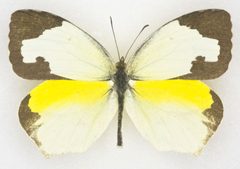
Eurema mexicana is a medium-sized yellow in the Pieridae, primarily distributed in Mexico with occasional northward strays into the southwestern and central United States. The is distinguished by a distinctive black forewing border forming a 'wolf-' or 'dog-face' pattern, and exhibits seasonal color variation on the wing underside. Males patrol hilltops and open areas seeking females throughout the day.

Pronunciation
How to pronounce Eurema mexicana: //juːˈriːmə ˌmɛksɪˈkɑːnə//
These audio files are automatically generated. While they are not always 100% accurate, they are a good starting point.
Identification
Distinguished from Eurema boisduvaliana (Boisduval's yellow) by larger size, duller yellow color, stronger 'dog ' pattern in males, more extensive black on female upperside, and more sharply pointed hindwing. Distinguished from Eurema salome (Salome yellow) by duller yellow color, more extensive black on upperside, and lack of round reddish spot near trailing edge on hindwing underside.
Images
Appearance
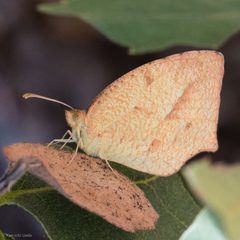
Wingspan 32–57 mm. Upperside pale yellow with black forewing submarginal border outlining a 'wolf-' or 'dog-face' pattern. Hindwing has small outer margin black border. Male has bright yellow patch on leading edge of hindwing. Hindwing sharply pointed. Underside pale yellow in summer individuals; pale yellow with reddish markings or entirely reddish-pink in winter individuals.
Habitat
Open including woodland edges, open woodlands, and desert grasslands.
Distribution
Primarily Mexico; occasionally central and southwestern United States (Arizona, Texas, New Mexico); rare stray to Canada (Manitoba, Saskatchewan).
Seasonality
Year-round in Arizona and Texas; April to November in New Mexico. Northward strays occur in late summer.
Diet
: nectar from flowers. Larvae: New Mexican locust (Robinia neomexicana), fern acacia (Acacia angustissima), prairie acacia (Acacia angustissima var. hirta), Cassia , and Diphysa robinoides.
Host Associations
- Robinia neomexicana - larval New Mexican locust
- Acacia angustissima - larval Fern acacia
- Acacia angustissima var. hirta - larval Prairie acacia
- Cassia - larval Multiple
- Diphysa robinoides - larval
Life Cycle
Complete . Larva green with creamy or yellow stripe and lateral yellow stripe. Three to four per year. Males patrol all day seeking females.
Behavior
Males patrol open areas and hilltops throughout daylight hours seeking females. Exhibits ' ' mating system where males compete through aerial pursuit and vertical spiraling when multiple males encounter the same female.
Ecological Role
of flowers as . Larvae function as herbivores on leguminous plants.
Human Relevance
Occasional garden visitor in southwestern United States; of minor interest to watchers due to distinctive pattern and seasonal color variation.
Similar Taxa
- Eurema boisduvalianaSmaller and brighter yellow; male has weaker 'dog ' pattern; female has reduced black on upperside; hindwing less sharply pointed.
- Eurema salomeBrighter yellow; more limited black on upperside; hindwing underside has round reddish spot near trailing edge.
More Details
Etymology
The 'wolf- sulphur' and alternative 'dog-face' pattern reference refer to the resemblance of the black forewing border pattern to a canine face.
Phenotypic plasticity
Seasonal produces summer individuals with pale yellow wing undersides and winter individuals with reddish or pinkish undersides, an likely related to or camouflage against different seasonal backgrounds.