
Colias palaeno
(Linnaeus, 1761)
Moorland Clouded Yellow, Palaeno Sulphur, Pale Arctic Clouded Yellow
Colias palaeno is a Holarctic in the Pieridae, occurring across northern Eurasia and North America. It inhabits moorlands, bogs, and open coniferous forests, with southern restricted to high alpine zones above 1,500 meters. The species has experienced significant declines in parts of its European range, particularly in Bavaria, where larval survival depends critically on microclimatic conditions associated with Sphagnum moss. It is , with flying from June to August.
Pronunciation
How to pronounce Colias palaeno: /ˈkoʊliæs pəˈlaɪənoʊ/
These audio files are automatically generated. While they are not always 100% accurate, they are a good starting point.
Identification
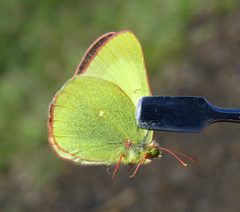
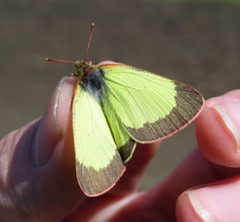
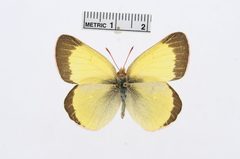
Distinguished from other Colias by combination of: pale yellow to white ground colour (not orange); red fringes on all wings; mother-of-pearl middle spot on hindwing underside; restriction to moorlands and bogs. Male similar to other 'clouded yellows' but paler; female white form distinctive. C. palaeno aias in Japan is notably larger with very broad forewing marginal band and rich green underside. C. chippewa (formerly C. p. chippewa) of northern North America may represent a separate species.
Images
Appearance
Wingspan 46–50 mm in males, 50–52 mm in females. Male upperside pale yellow with blackish brown margins, pale-centred dark middle spot on forewing and light middle spot on hindwing; fringes red. Underside of forewing pale yellow with white-centred dark middle spot, costal and distal edges red; hindwing yellow, strongly dusted with fuscous, large middle spot mother-of-pearl colour, fringes red. Female upperside white; underside of forewing white proximally, yellow at apex; hindwing paler than male. Larva sea-green, velvety, with minute black dots; lateral stripe bright yellow edged with black beneath; white with black edges. Pupa greenish yellow with strongly convex back.
Habitat
Moorlands, bogs, forest meadows, open coniferous forests, and open areas with scrub. In southern parts of range, restricted to high alpine zones above 1,500 m elevation; at lower latitudes found on upland bogs around 1,000 m. Larval microhabitat specifically requires Vaccinium uliginosum growing over living Sphagnum moss cushions; survival is poor where food plant grows among other mosses or litter due to unfavourable microclimate.
Distribution
Holarctic: northern and central Europe from eastern France to Baltic States, northern Scandinavia, and eastern Europe; east through Siberia to Chukchi Peninsula, Kamchatka, Sakhalin, and Japan; northern North America including Alaska, Canada, and northern contiguous United States. Multiple recognized across range: C. p. palaeno (Fennoscandia, Estonia), C. p. aias (Japan), C. p. baffinensis and C. p. chippewa (northern North America), C. p. europome (central Europe), C. p. europomene (Alps), C. p. orientalis (Kamchatka), C. p. poktusani (North Korea), C. p. sachalinensis (Sakhalin), C. p. synonyma (Sweden, Denmark).
Seasonality
; fly from June to August. Timing varies with latitude and elevation.
Diet
Larvae feed on Vaccinium uliginosum (bog bilberry), also recorded on Vaccinium myrtillus and Vaccinium caespitosum. Larvae scrape the surface of young leaves. diet not specified in sources.
Host Associations
- Vaccinium uliginosum - larval food plantcritical; larval survival depends on plant growing over living Sphagnum moss
- Vaccinium myrtillus - larval food plantsecondary
- Vaccinium caespitosum - larval food plantsecondary
- Sphagnum - microhabitat facilitatorliving moss cushions create favourable microclimate for larval survival
Life Cycle
. laid on plants. Larvae feed on young leaves, scraping the surface. Young caterpillars must survive until hibernation; pre-hibernation mortality is a critical factor. occurs after hibernation. emerge June–August. Complete details of egg and pupal stages not specified in sources.
Behavior
Strong, active flyer typical of Colias . occasionally found far from suitable breeding grounds, suggesting capacity. Larvae exhibit specific microhabitat fidelity, with survival linked to immediate vegetation structure rather than food plant quality alone.
Ecological Role
in moorland and alpine . Larval herbivore on Vaccinium . Serves as for intact bog ecosystems with specific Sphagnum-dominated microhabitats.
Human Relevance
Significant declines in Europe, particularly Bavaria, have prompted conservation research. Climate change and bog degradation (desiccation, woody plant encroachment) threaten populations. Not considered an agricultural pest.
Similar Taxa
- Colias chippewaFormerly treated as C. p. chippewa; may represent separate ; occurs in northern North America
- Colias aiasTreated as full by some authors; Japanese , notably larger with broad forewing marginal band and rich green underside
- Colias eurythemeOrange sulphur/alfalfa butterfly; similar but orange-yellow colouration, agricultural pest, different and range
- Colias croceusClouded yellow; brighter orange-yellow, migratory in Europe, different preference
More Details
Microclimate Sensitivity
Research in Bavaria demonstrates that larval survival is not determined by food plant vigor alone. Sites where Vaccinium uliginosum grows robustly among non-Sphagnum mosses or litter show high caterpillar mortality during warm, dry summers. Living Sphagnum cushions buffer temperature and moisture, creating essential microclimatic refugia. This explains paradoxical observations of decline despite apparently suitable .
Climate Change Vulnerability
Two main of threat identified: (1) increased frequency of hot, dry summers directly increasing larval mortality, and (2) bog changes including desiccation and woody plant encroachment altering microhabitat structure. Both reduce availability of Sphagnum-associated microsites.
Taxonomic Uncertainty
Subspecific classification varies among authors. C. aias and C. chippewa have been elevated to rank by some authorities. The Japanese (aias) is notably divergent in size and coloration; the North American chippewa complex requires further systematic study.
Sources and further reading
- BugGuide
- Wikipedia
- GBIF taxonomy match
- iNaturalist taxon
- NCBI Taxonomy
- Catalogue of Life
- A Butterfly Invasion in Yolo, Solano and Sacramento Counties | Bug Squad
- Acta Biologica Sibirica signs with Pensoft and moves to ARPHA | Blog
- Der Hochmoorgelbling (Colias palaeno) – das Mikroklima der Larvallebensräume ist entscheidend für sein Überleben