
Colias eurytheme
Boisduval, 1852
Orange Sulphur, Alfalfa Butterfly, Alfalfa Caterpillar
Colias eurytheme, the orange sulphur or alfalfa , is a widespread North American pierid butterfly found from southern Canada to Mexico. The is highly variable in coloration, with both orange and white morphs present, and exhibits complex thermal and dynamics. Larvae are significant agricultural pests of alfalfa and other legumes, while are known for mass events when crops are harvested. The species has been extensively studied for its metabolic responses to temperature, costs of mating in females, and disruptive sexual selection patterns.
Pronunciation
How to pronounce Colias eurytheme: /ˈkoʊ.li.əs ˈjuː.rɪ.θɛm/
These audio files are automatically generated. While they are not always 100% accurate, they are a good starting point.
Identification
Distinguished from similar Colias by combination of orange ground color (in typical morph), black marginal wing markings, and presence in lowland rather than alpine . Males can be separated from C. philodice by UV wing patterns visible under ultraviolet light. Larvae identified by velvety green body with white-pink lateral stripes and presence on alfalfa or other legumes. White female morph distinguished from Pieris species by wing shape and pattern details.
Images
Appearance
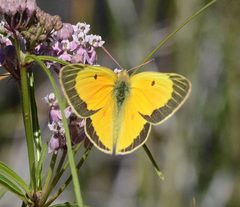
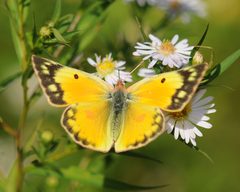
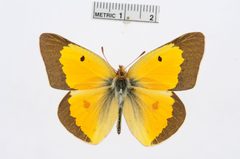
are medium-sized butterflies with wingspan approximately 32-54 mm. Upper wing surface is typically orange-yellow in males, with females showing both orange and white (alba) morphs; approximately 35% of females are white. Wings display variable black marginal markings. Underside of hindwing shows a silvery spot. Larvae are velvety green with white-and-pink lateral lines and variable black markings, reaching approximately 1.5 inches at maturity. Pupa is apple-green with rosy highlights. are red and laid singly.
Habitat
Open including agricultural fields, grasslands, meadows, roadsides, and urban gardens. Strongly associated with cultivated alfalfa fields and legume-rich environments. Overwinters as larvae primarily in vetch at low altitudes; colonizes alfalfa as vetch senesces in May-June. Also breeds on clovers, sweet clovers, and occasionally lupines in wildlands.
Distribution
Throughout North America from southern Canada to Mexico. Present across western and central United States; absent from central and southeastern United States. Irregular occurrence in Canadian prairie provinces (Alberta, Manitoba, Saskatchewan). Regional dynamics documented in California Central Valley, with periodic mass movements into urban areas.
Seasonality
Multiple per year (4-7 generations), with activity from spring through fall. Peak abundance typically midsummer to autumn. Mass events triggered by alfalfa harvest, particularly July-September in Central Valley. occurs as larval stage. Secondary sometimes follow initial late summer outbreaks by 4-6 weeks.
Diet
Larvae feed on leaves and new growth of leguminous plants, particularly alfalfa (Medicago sativa), clovers (Trifolium spp.), vetches (Vicia spp.), sweet clovers (Melilotus spp.), and Spanish lotus. nectar on diverse flowering plants including , clover blossoms, and other available sources.
Host Associations
- Medicago sativa - primary larval Major agricultural pest; laid on new growth under 6 inches tall
- Trifolium - larval Includes clovers in lawns and wildlands
- Vicia - vetch primary site at low altitudes
- Melilotus - larval Sweet clovers
- Lotus - larval Spanish lotus and related
Life Cycle
Complete with four stages: , larva, pupa, . Eggs hatch in 3-7 days; larval stage lasts through five instars, duration varying with temperature. occurs in apple-green chrysalis. synchronized with hay-cutting cycles, with larvae pupating before cutting. Four to seven generations annually depending on region and climate. Overwinters as larva in vetch.
Behavior
engage in rapid, direct . Males patrol for females and exhibit UV-based mate recognition. Females exhibit polyandrous mating with multiple partners. Mass triggered by agricultural disturbance, particularly alfalfa cutting, resulting in directional movements into urban and non-agricultural areas. Thermoregulatory behavior documented, with narrow body temperature range (31-39°C) for optimal flight performance.
Ecological Role
Larval stage functions as significant herbivore on leguminous plants, occasionally reaching pest densities in agricultural systems. serve as when nectaring. influenced by natural enemies including ; hyperparasitoids may reduce effectiveness. Part of complex in agricultural and grassland .
Human Relevance
Major economic pest of alfalfa production, with caterpillars defoliating crop and reducing hay quality and yield. Subject to extensive research in thermal , , and metabolic physiology. Used as model organism for studying costs of and temperature effects on insect muscle metabolism. Mass events occasionally create nuisance conditions in urban areas.
Similar Taxa
- Colias philodiceSimilar size and coloration; distinguished by male UV wing pattern differences visible under ultraviolet light, and typically occupies different zones
- Pieris rapaeWhite female morph of C. eurytheme resembles cabbage white; distinguished by wing shape, pattern details, and coloration
- Colias behriiAnother Colias sulphur; distinguished by alpine preference and geographic separation
More Details
Metabolic Thermal Biology
muscle adenylate pools show complex responses to body temperature. /ADP ratio peaks at 35°C, near the base of the behavioral thermal optimum, declining at 39°C—supporting hypothesis that narrow reflects system-based constraints on energy processing breadth rather than simple thermal damage limits.
Sexual Selection Dynamics
Disruptive operates on male courtship composition, with males at opposite ends of chemical variation distribution having disproportionate mating success with white versus orange female morphs. This increases rather than stabilizes intraspecific variation in this trait.
Female Mating Costs
Mated females show reduced longevity compared to virgins under controlled conditions, independent of effects—suggesting potential toxic side effects of male ejaculate, though lifetime production remains equivalent between mated and virgin females.
Sources and further reading
- BugGuide
- GBIF taxonomy match
- iNaturalist taxon
- NCBI Taxonomy
- Catalogue of Life
- A Butterfly Invasion in Yolo, Solano and Sacramento Counties | Bug Squad
- 'Battus philenor! Battus philenor!' | Bug Squad
- A Boy, Bugs, a Birthday and the Bohart | Bug Squad
- The Joy of Rearing Monarchs | Bug Squad
- Thinking of Noted Cotton Entomologist Thomas Frances Leigh | Bug Squad
- Friday Flower – Dwarf Spiderwort | Beetles In The Bush
- Habitat: Colias philodice eriphyle and Colias Eurytheme
- Man-made habitat for Colias eurytheme
- Disruptive sexual selection in Colias eurytheme butterflies.
- The Effect of X-Chromosome Inheritance on Mate-Selection Behavior in the Sulfur Butterflies, Colias eurytheme and C. philodice
- A survival cost to mating in a polyandrous butterfly, Colias eurytheme
- Flight-muscle adenylate pool responses to flight demands and thermal constraints in individual Colias eurytheme (Lepidoptera, pieridae)