
Colias philodice
Godart, [1819]
common sulphur, clouded sulphur
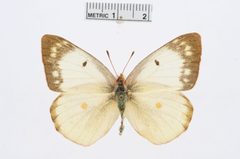
Colias philodice is a North American pierid commonly known as the clouded sulphur or common sulphur. It is a multivoltine that produces multiple per year. are typically pale yellow above with no orange traces, distinguishing them from the closely related orange sulphur (C. eurytheme). Females exhibit a white form (alba) that can be common in some . The species is a legume-feeder whose larvae primarily develop on alfalfa (Medicago sativa) and various clovers, making it economically significant in agricultural settings. It ranges across most of North America except for the far northern regions of Labrador, Nunavut, and northern Quebec.
Pronunciation
How to pronounce Colias philodice: /ˈko.li.æs ˌfi.ləˈdaɪ.ki/
These audio files are automatically generated. While they are not always 100% accurate, they are a good starting point.
Identification
Males have clean wing borders while females have yellow dots within the border region. The hindwings display a series of four small red spots along the outer third, a trait shared with C. eurytheme but not with C. interior. Underside of male wings is yellow; female underside is yellow or greenish-white. Both sexes have a doubled hindwing spot trimmed in brownish-red. Wingspan 32–54 mm. The white form (alba) in females can be distinguished from C. eurytheme alba by border pattern when normal specimens are present; some individuals cannot be separated without reference specimens. White form males are exceedingly rare.
Images
Habitat
Open including fields, lawns, alfalfa or clover fields, meadows, and roadsides. frequently congregate at mud puddles.
Distribution
Most of North America; absent from Labrador, Nunavut, and northern Quebec. Present in Canadian provinces including Alberta, Manitoba, and Saskatchewan, and throughout the United States.
Seasonality
Multivoltine with multiple per year; active spring through fall. Migratory move annually.
Diet
Larvae feed on legumes (Fabaceae), primarily alfalfa (Medicago sativa), white clover (Trifolium repens), red clover (Trifolium pratense), and various other Trifolium . Also recorded on deer vetch (Lotus species), white sweet clover (Melilotus albus), ground-plum (Astragalus crassicarpus), and other Astragalus species. nectar at milkweeds (Asclepias), bush (Buddleja), coneflowers (Echinacea, Rudbeckia), dandelion (Taraxacum), tall verbena (Verbena bonariensis), and numerous other flowers.
Host Associations
- Medicago sativa - primary larval alfalfa
- Trifolium repens - larval white clover
- Trifolium pratense - larval red clover
- Melilotus albus - larval white sweet clover
- Astragalus crassicarpus - larval ground-plum
- Astragalus plattensis - larval Platte River milk-vetch
- Lotus species - larval deer vetch
- Robinia pseudoacacia - larval black locust
- Prunella vulgaris - larval self-heal
- Vicia species - larval vetch
- Glycine max - larval soybean
Life Cycle
Pale yellow laid singly on plants; eggs turn red after a few days, then gray before hatching. Larvae are green with white stripes along each side, sometimes with pink or orange bars. Young larvae exhibit . Green chrysalis hangs upright by silken girdle; turns yellow with pink 'zipper' just before . Multivoltine with multiple per year. Overwinters as larva primarily in vetch at low altitudes, colonizing alfalfa as vetch senesces in May–June.
Behavior
engage in mud-puddling , congregating at mud puddles in swarms. Virgin females discriminate males from C. eurytheme males using scent cues. Receptive females assume a fixed position with held ventrally between hindwings. Exhibits . Larvae show facultative monophagy based on prior feeding experience—early experience on a particular can lead to behavioral and physiological specialization for that host.
Ecological Role
of diverse flowering plants through nectar-feeding. Larval herbivore on leguminous plants, with significant economic impact as a pest of alfalfa. Serves as prey for various and . Relative to herbivores of non-legume C3 plants, appears less affected by elevated atmospheric CO2 due to nitrogen-fixing capacity of legume .
Human Relevance
Significant agricultural pest of alfalfa; caterpillars damage crop when are high. Subject of extensive research in chemical , range evolution, and climate change . Popular with watchers and photographers. Used in educational contexts for rearing and observation.
Similar Taxa
- Colias eurythemeOrange sulphur; may also be yellowish but typically shows orange traces, especially in males; males lack UV-reflective pattern present in C. philodice males; hindwing red spot pattern similar; alba forms can be difficult to distinguish without reference specimens
- Colias interiorPink-edged sulphur; lacks four red spots on hindwing outer third; with different ; feeds on Vaccinium rather than legumes
- Pieris rapaeCabbage white; white form alba of C. philodice may be confused with this , but differs in style and wing pattern details
- Pontia protodiceCheckered white; white form alba of C. philodice may be confused with this , but differs in style and wing pattern details
More Details
UV reflectance and mate recognition
Males of C. philodice possess UV-reflective wing surfaces while C. eurytheme males do not; this difference is visually apparent under UV light and plays a behavioral role in courtship. Virgin females use scent to discriminate males from C. eurytheme males.
Host range evolution
have demonstrated documented shifts in plant preference, including of introduced legumes such as alfalfa and Coronilla varia. This represents a well-studied example of host range expansion in phytophagous insects.
Elevated CO2 response
Unlike herbivores of non-legume C3 plants, C. philodice larvae are relatively buffered against effects of elevated atmospheric CO2 due to the nitrogen-fixing capacity of legume , which maintain leaf nitrogen content under elevated CO2 conditions.
Hybridization
When hybridized with the C. interior, hybrid larvae exhibit abnormal dynamics—approximately 50% cease feeding but fail to enter diapause, subsequently starving—and show reduced utilization on legume hosts.
Blue-green caterpillar mutation
A mutation affecting color produces blue-green caterpillars; the origin and of this mutation has been investigated.
Sources and further reading
- BugGuide
- Wikipedia
- GBIF taxonomy match
- iNaturalist taxon
- NCBI Taxonomy
- Catalogue of Life
- A Butterfly Invasion in Yolo, Solano and Sacramento Counties | Bug Squad
- 'Battus philenor! Battus philenor!' | Bug Squad
- A Boy, Bugs, a Birthday and the Bohart | Bug Squad
- The Joy of Rearing Monarchs | Bug Squad
- Thinking of Noted Cotton Entomologist Thomas Frances Leigh | Bug Squad
- Friday Flower – Dwarf Spiderwort | Beetles In The Bush
- Habitat: Colias philodice eriphyle and Colias Eurytheme
- Change of Host Preference in Colias philodice
- Diapause Dynamics And Host Plant Utilization of <i>Colias Philodice, Colias Interior</i> and Their Hybrids (Lepidoptera: Pieridae)
- Predicting Host Range Evolution: Colonization of Coronilla varia by Colias philodice (Lepidoptera: Pieridae)
- Host Range Evolution: The Shift From Native Legume Hosts to Alfalfa by the Butterfly, Colias philodice eriphyle
- The Effect of X-Chromosome Inheritance on Mate-Selection Behavior in the Sulfur Butterflies, Colias eurytheme and C. philodice
- Facultative monophagy as a consequence of prior feeding experience: behavioral and physiological specialization in Colias philodice larvae
- Blue-green caterpillars: The origin and ecology of a mutation in hemolymph color in Colias (Eurymus) philodice
- Blue‐green caterpillars: The origin and ecology of a mutuation in hemolymph color in Colias (Eurymus) philodice
- PREDICTING HOST RANGE EVOLUTION: COLONIZATION OFCORONILLA VARIABYCOLIAS PHILODICE(LEPIDOPTERA: PIERIDAE)
- THE EFFECT OF X-CHROMOSOME INHERITANCE ON MATE-SELECTION BEHAVIOR IN THE SULFUR BUTTERFLIES,COLIAS EURYTHEMEANDC. PHILODICE
- Ultraviolet reflection and its behavioral role in the courtship of the sulfur butterflies Colias eurytheme and C. philodice (Lepidoptera, Pieridae)
- Are legume‐feeding herbivores buffered against direct effects of elevated carbon dioxide on host plants? A test with the sulfur butterfly, Colias philodice
- HOST RANGE EVOLUTION: THE SHIFT FROM NATIVE LEGUME HOSTS TO ALFALFA BY THE BUTTERFLY, COLIAS PHILODICE ERIPHYLE