
Colias behrii
Edwards, 1863
Behr's sulphur, Sierra green sulfur, Sierra Sulphur
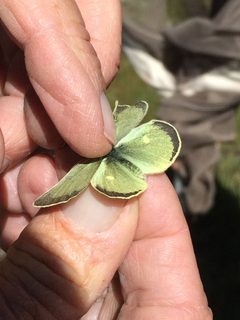
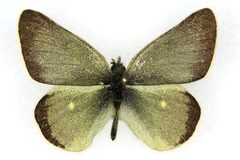
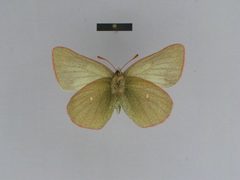
Colias behrii is a small alpine to the Sierra Nevada of California, restricted to high-elevation mostly around and above 9,000 feet. It has a wingspan of 35–42 mm and is active from July to August. The has been subject to genetic study revealing a historical range-wide bottleneck approximately 531–281 years ago, coinciding with a period of global cooling.
Pronunciation
How to pronounce Colias behrii: /ˈkoʊ.li.əs ˈbɛə.raɪ/
These audio files are automatically generated. While they are not always 100% accurate, they are a good starting point.
Identification
Distinguished from other Colias by its restricted high-elevation distribution in the Sierra Nevada; are on wing in mid-summer (July–August) when many other alpine butterflies have completed their period. The species' alpine preference separates it from lower-elevation sulphurs such as Colias eurytheme.
Images
Habitat
Alpine meadows and high-elevation in the Sierra Nevada, mostly around and above 9,000 feet elevation.
Distribution
to California's Sierra Nevada from Tuolumne County south to Tulare County.
Seasonality
are on wing from July to August.
Diet
feed on flower nectar. Larvae feed on Vaccinium and Gentiana newberryi.
Host Associations
- Vaccinium - larval plant not specified
- Gentiana newberryi - larval plant
Life Cycle
stage not explicitly documented; supercooling points have been studied in comparison to Parnassius clodius, suggesting diapausing eggs with cold adaptations.
Human Relevance
Subject of research on cold and thermal ; reared in captivity for study and educational purposes. The has been featured in seminars at the Bohart Museum of Entomology.
Similar Taxa
- Colias eurythemeBoth are yellow sulphur butterflies in the Colias, but C. eurytheme occurs at lower elevations in agricultural and urban areas, has multiple per year, and is a significant pest of alfalfa
- Parnassius clodiusShares high-elevation and cold-adapted ; both have been studied for thermal of , though P. clodius belongs to Papilionidae and has different larval plants
More Details
Genetic history
Microsatellite data indicate a range-wide genetic bottleneck 531–281 years ago followed by rapid growth, coinciding with the Little Ice Age. This demographic event overwhelms contemporary landscape factors in shaping genetic patterns.
Conservation concern
Like other alpine , the is vulnerable to climate change; rising tree lines would eliminate its high-elevation with no higher ground available for range shift.
Sources and further reading
- BugGuide
- Wikipedia
- GBIF taxonomy match
- iNaturalist taxon
- NCBI Taxonomy
- Catalogue of Life
- A Boy, Bugs, a Birthday and the Bohart | Bug Squad
- The Joy of Rearing Monarchs | Bug Squad
- A Butterfly Invasion in Yolo, Solano and Sacramento Counties | Bug Squad
- How the UC Davis Research Scholars Program in Insect Biology Shines | Bug Squad
- Meet a UC Davis Student Who Is Researching the Cold-Adapted Parnassian Butterflies | Bug Squad
- 'Battus philenor! Battus philenor!' | Bug Squad
- A range‐wide genetic bottleneck overwhelms contemporary landscape factors and local abundance in shaping genetic patterns of an alpine butterfly (Lepidoptera: Pieridae: Colias behrii)