
Colias gigantea
Strecker, 1900
Giant Sulphur, Giant Northern Sulfur
Colias gigantea, the giant sulphur, is a medium-sized in the Pieridae found across northern North America. It inhabits tundra and willow bog from Alaska eastward across Canada to the Atlantic coast, with disjunct in the northern Rocky Mountains. are active from June through early August, with larvae feeding exclusively on willow (Salix spp.) and adults taking flower nectar.
Pronunciation
How to pronounce Colias gigantea: //ˈkoʊ.li.əs dʒɪˈɡæn.ti.ə//
These audio files are automatically generated. While they are not always 100% accurate, they are a good starting point.
Identification
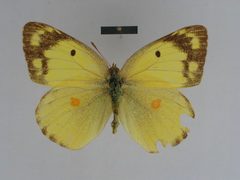
Distinguished from other North American sulphurs by its larger size (wingspan to 55 mm versus typically 30–45 mm in related ) and its restriction to northern and tundra . The combination of large size, geographic range, and habitat specificity separates it from the more widespread Colias philodice and Colias eurytheme. C. g. harroweri in the Rocky Mountain states may show geographic variation in coloration.
Images
Appearance
Wingspan 37–55 mm. Coloration typical of sulphur butterflies (yellow-orange ground color with dark wing borders), though specific pattern details are not well documented in available sources. The "giant sulphur" refers to its relatively large size compared to other Colias .
Habitat
Tundra and willow bogs. Occupies open, wet in the northern zone where willow shrubs provide larval food plants.
Distribution
Alaska across Canada to the east coast, including Yukon, Northwest Territories, British Columbia, Alberta, Saskatchewan, Manitoba, and Ontario. Disjunct in Wyoming, Montana, and Oregon ( C. g. harroweri).
Seasonality
period from June until early August. Single-brooded or with limited second in southern parts of range.
Diet
Larvae feed on Salix spp. (willows). feed on flower nectar.
Host Associations
- Salix - larval food plant-level association; specific willow not documented in available sources
Life Cycle
Holometabolous with complete . laid on plants. Larval development on willow foliage. presumably on or near host plants, though pupal stage details are not documented. in early summer.
Ecological Role
serve as when nectaring. Larvae are herbivores that consume willow foliage. Part of the Arctic and fauna adapted to short growing seasons.
Similar Taxa
- Colias philodiceOverlaps in eastern Canada; smaller size (wingspan ~35–45 mm) and preference for open fields and meadows rather than tundra/willow bogs
- Colias eurythemeSouthern distribution, associated with agricultural areas and alfalfa fields; smaller and more orange in coloration
- Colias interiorAnother northern sulphur with overlapping range; distinguished by preference and subtle wing pattern differences
More Details
Subspecies
Three recognized: C. g. gigantea (nominate, throughout main Canadian range); C. g. harroweri Klots, 1940 (Wyoming, Montana, Oregon); C. g. mayi F. & R. Chermock, 1940 (distribution not specified in available sources)
Sources and further reading
- BugGuide
- Wikipedia
- GBIF taxonomy match
- iNaturalist taxon
- NCBI Taxonomy
- Catalogue of Life
- A Butterfly Invasion in Yolo, Solano and Sacramento Counties | Bug Squad
- 'Battus philenor! Battus philenor!' | Bug Squad
- A Boy, Bugs, a Birthday and the Bohart | Bug Squad
- The Joy of Rearing Monarchs | Bug Squad
- North America’s largest jewel beetle | Beetles In The Bush
- Gelechiidae | Beetles In The Bush