
Battus philenor hirsuta
(Skinner, 1908)
California pipevine swallowtail, hairy pipevine swallowtail
A California of pipevine swallowtail distinguished by smaller size, denser body hair, and larger clutches than the nominate subspecies. display iridescent green-blue hindwings with red spots, while larvae are black with fleshy protrusions and orange markings. The subspecies maintains a tightly coupled relationship with its sole plant, Aristolochia californica, sequestering toxic aristolochic acids for chemical defense. Unlike other Battus philenor , this subspecies has no known Batesian mimics.

Pronunciation
How to pronounce Battus philenor hirsuta: /ˈbætəs faɪˈliːnɔr hɪrˈsuːtə/
These audio files are automatically generated. While they are not always 100% accurate, they are a good starting point.
Identification
Distinguished from nominate Battus philenor philenor by: smaller overall size, denser body hair, and larger clutch sizes. Geographic separation provides additional diagnostic context—this occurs only in northern California, isolated from other pipevine swallowtail . The combination of iridescent blue-green hindwings with red spots and exclusive association with Aristolochia californica confirms identification within its range.
Images
Habitat
Riparian corridors, chaparral, and woodland of the California Coast Ranges, Sacramento Valley, and Sierra Nevada foothills. Specifically associated with stream courses and moist environments where the plant Aristolochia californica grows. occur in both ecologically intact areas and landscapes modified by urban, suburban, and agricultural development.
Distribution
to northern California, United States. Core range includes the Sacramento Valley, with outlying in Contra and Alameda counties. Extends north to the edge of the Klamath ranges near Redding and south along the western flank of the Central Sierra foothills and adjoining riparian corridors of the eastern Central Valley. Historically present in San Francisco, where reintroduction efforts have occurred.
Seasonality
fly from late winter (February–March) through autumn (October, occasionally November). Two major peaks occur before July 4, followed by stragglers and occasional August increases. Early season abundance depends on plant growth; -laying sites become limited when Aristolochia californica stops growing in June unless disturbance (fire, cutting) stimulates new shoot production.
Diet
Larvae feed exclusively on foliage and shoot tips of Aristolochia californica. consume floral nectar from diverse plants including wild radish (Raphanus), California buckeye, blue dicks, Ithuriel's Spear, Yerba Santa, and yellow starthistle.
Host Associations
- Aristolochia californica - obligateCalifornia pipevine or Dutchman's Pipe; sole viable plant for all larval stages. Larvae feed on young tender shoot tips initially, later on mature leaves and fruits. Aristolochia in gardens are not viable hosts despite occasional oviposition.
Life Cycle
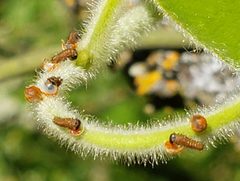
deposited on young, tender, growing shoot tips of plant. Larvae initially feed gregariously, scattering as they grow through five instars. Larvae move frequently between leaves because damaged leaves increase and palatability declines. occurs after larval development complete. live approximately one month. Multiple per year with season extending February through November.
Behavior
Larvae exhibit gregarious feeding , distinguishing this from nominate B. philenor where larvae are more solitary. are strong, conspicuous fliers. Females oviposit exclusively on new plant growth; will opportunistically use post-fire or post-cutting regrowth when available. Adults readily visit flowers for nectar and can be observed nectaring on non-native plants when native bloom is scarce.
Ecological Role
Serves as model for in other B. philenor , though no mimics are known for this California . Functions as flagship for California biodiversity and plant-insect research. Chemical of aristolochic acids creates distastefulness that protects against vertebrate . Tight ecological coupling with Aristolochia californica makes this a model system for studying coevolution and potential co-extinction dynamics.
Human Relevance
Subject of conservation concern due to loss and plant decline. Reintroduction efforts in San Francisco (initiated 2017 by California Academy of Sciences biologist Tim Wong) involved captive rearing and release at San Francisco Garden. sequenced as part of California Conservation Project. Long-term monitoring by UC Davis researcher Art Shapiro since 1972 provides one of the most extensive datasets in North America.
Similar Taxa
- Battus philenor philenorNominate ; distinguished by larger size, less dense hair, smaller clutches, and distribution outside California.
- Battus polydamasPolydamas swallowtail; also sequesters aristolochic acids and shares warning coloration, but lacks hindwing tails and has different geographic range.
More Details
Chemical Defense
Both larvae and contain high concentrations of aristolochic acids sequestered from Aristolochia californica. These compounds are mutagenic, carcinogenic, and toxic to vertebrate kidneys, rendering the distasteful to . Acid concentrations in California are comparable to Arizona populations involved in mimicry complexes, indicating that low does not explain the absence of mimics in California.
Genomic Resources
First -level assembly for the Battus completed in 2023: 109 scaffolds spanning 443 Mb with 98.9% BUSCO completeness. Produced as part of the California Conservation Project to support landscape genomic diversity studies.
Population Trends
Listed among 'doing well' in central California long-term monitoring, though this assessment applies to Battus philenor broadly. The ' restricted range and plant specificity may increase vulnerability to localized extinction compared to the widespread nominate subspecies.
Sources and further reading
- BugGuide
- Wikipedia
- GBIF taxonomy match
- iNaturalist taxon
- Pipevine Swallowtail: Battus philenor! Battus philenor! | Bug Squad
- 'Battus philenor! Battus philenor!' | Bug Squad
- Big Bioblitz Set April 29 at UC Davis: Plants, Animals and More | Bug Squad
- What Effect Did the California Drought Have on Butterflies? | Bug Squad
- Mary Louise Flint's Article in The Acorn: 'Butterflies in Decline' | Bug Squad
- Model butterflies: Pipevine swallowtail, Battus philenor, and Polydamas swallowtail, Battus polydamas — Bug of the Week
- A draft reference genome assembly of the Pipevine Swallowtail butterfly, Battus philenor hirsuta
- A Model Without a Mimic: Aristolochic Acids from the California Pipevine Swallowtail, Battus philenor hirsuta, and Its Host Plant, Aristolochia californica