
Battus polydamas
(Linnaeus, 1758)
Polydamas Swallowtail, Gold Rim Swallowtail, Tailless Swallowtail
Species Guides
2- Battus polydamas lucayus(Florida Polydamas Swallowtail)
- Battus polydamas polydamas(Polydamas Swallowtail)
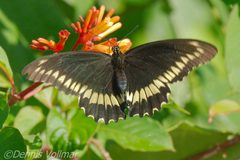
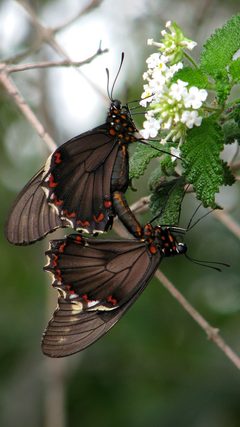
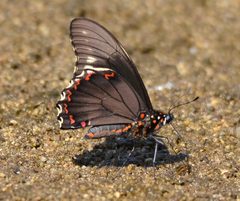
Battus polydamas is a tailless distinguished by black wings with yellow submarginal spots and red hindwing lunules. First described by Linnaeus in 1758, it occurs throughout the Neotropics and southern United States. Larvae are obligate on Aristolochia (pipevine) plants, sequestering toxic aristolochic acids for chemical defense against .
Pronunciation
How to pronounce Battus polydamas: //ˈbætəs ˌpɒlɪˈdeɪməs//
These audio files are automatically generated. While they are not always 100% accurate, they are a good starting point.
Identification
Distinguished from other swallowtails by complete absence of hindwing tails. Black ground color with yellow spots differs from red-spotted purple (Limenitis arthemis astyanax) which has blue iridescence and orange marginal spots. Battus philenor (pipevine swallowtail) has iridescent blue hindwings and more extensive blue scaling. Polydamas shows red (not blue) on hindwing undersides.
Images
Habitat
Open woodlands, forest edges, abandoned fields, and gardens containing larval plants. Strongly associated with presence of Aristolochia vines. Occurs from sea level to moderate elevations in tropical and subtropical zones.
Distribution
Widespread in : Mexico, Central America, South America, Caribbean islands (Jamaica, Cuba, Puerto Rico, Hispaniola, Lesser Antilles), and southern United States (Texas, Florida). Multiple recognized across range, including B. p. lucayus in Florida/Bahamas and B. p. archidamas in Chile.
Seasonality
April to November in three in northern range; continuous breeding with multiple generations year-round in tropical regions.
Diet
Larvae feed exclusively on Aristolochia (pipevines). nectar at diverse flowers including wild radish, bush, and other available blooms.
Host Associations
- Aristolochia - obligate larval on 24+ ; sequesters aristolochic acids for defense
Life Cycle
Females deposit orange in clusters on young shoot tips of plants. Early instar larvae feed gregariously; later instars disperse. Larval development rate and survival vary significantly among host . occurs after larval accumulation of defensive compounds. transfer sequestered toxins to eggs, protecting offspring.
Behavior
Larvae evert osmeterium and release volatile secretions (primarily germacrene A with minor monoterpenes and sesquiterpenes) when disturbed, deterring including ants. bask openly in sunshine, advertising aposematic coloration.
Ecological Role
Serves as model for complexes; its warning coloration is copied by palatable butterflies. Functions as during nectar-feeding. Larval specialization on toxic plants influences structure of co-occurring herbivores.
Human Relevance
Occasional garden visitor where plants cultivated. Subject of ecological research on chemical defense, host plant specialization, and climate change effects on plant-insect interactions. Not considered agricultural pest.
Similar Taxa
- Battus philenorShares Aristolochia association and aposematic black coloration, but has iridescent blue hindwings and more extensive blue scaling; occurs in overlapping range in North America
- Limenitis arthemis astyanaxBatesian mimic with similar black base color, but has blue iridescence and orange marginal spots rather than yellow submarginal spots; has reduced tails
More Details
Chemical defense
Aristolochic acids sequestered from plants are mutagenic, carcinogenic, and nephrotoxic to vertebrates. Larvae show differential in response to host chemistry, with upregulation of detoxification genes including P450s, UGTs, and glutathione S-transferases.
Climate sensitivity
Experimental warming (+2.7°C) increases aristolochic acid content in plants, paradoxically enhancing larval growth and food conversion , suggesting complex trophic responses to climate change.
Sources and further reading
- BugGuide
- Wikipedia
- GBIF taxonomy match
- iNaturalist taxon
- NCBI Taxonomy
- Catalogue of Life
- Pipevine Swallowtail: Battus philenor! Battus philenor! | Bug Squad
- 'Battus philenor! Battus philenor!' | Bug Squad
- Big Bioblitz Set April 29 at UC Davis: Plants, Animals and More | Bug Squad
- Model butterflies: Pipevine swallowtail, Battus philenor, and Polydamas swallowtail, Battus polydamas — Bug of the Week
- How Belizean butterflies best their enemies: Polydamas Swallowtail, Battus polydamas — Bug of the Week
- Archive — Bug of the Week
- Polydamas Swallowtail, Gold Rim, Tailless Swallowtail, Battus polydamas lucayus (Rothschild & Jordan) (Insecta: Lepidoptera: Papilionidae: Troidini)
- ARISTOLOCHIC ACIDS FROM ARISTOLOCHIA BRIDGESII, A HOST-PLANT OF BATTUS POLYDAMAS ARCHIDAMAS
- ESSENTIAL OIL COMPOSITION OF ARISTOLOCHIA CHILENSIS A HOST PLANT OF BATTUS POLYDAMAS
- Host Quality in the Development Cycle of Battus Polydamas (Lepidoptera: Papilionidae: Troidini)
- Aristolochic acids affect the feeding behaviour and development of Battus polydamas archidamas larvae (Lepidoptera: Papilionidae: Troidini)
- A New Herbivory Report from Southeastern Brazil: Aristolochia hypoglauca Kuhlm (Piperales: Aristolochiaceae) as a Host Plant for Battus polydamas (Linnaeus, 1758) (Lepidoptera: Papilionidae)
- Mode of action, chemistry and defensive efficacy of the osmeterium in the caterpillar Battus polydamas archidamas
- Co-occurrence of host plants associated with plant quality determines performance patterns of the specialist butterfly, Battus polydamas archidamas (Lepidoptera: Papilionidae: Troidini)
- Climate change-related warming-induced shifts in leaf chemical traits favor nutrition of the specialist herbivore Battus polydamas archidamas
- Use of volatiles of Aristolochia chilensis (Aristolochiaceae) in host searching by fourth-instar larvae and adults of Battus polydamas archidamas (Lepidoptera: Papilionidae: Troidini)
- Battus polydamas(Lepidoptera: Papilionidae) Uses the Open-FieldAristolochia sessilifolia(Piperales: Aristolochiaceae) as Its Host Plant in Uruguayan Savanna Areas
- Differential gene expression toward species of Aristolochia impairing the performance of the Troidini butterfly Battus polydamas
- Author Correction: Mode of action, chemistry and defensive efficacy of the osmeterium in the caterpillar Battus polydamas archidamas.