
Papilio ornythion
Boisduval, 1836
ornythion swallowtail
Papilio ornythion is a in the Papilioninae, native to Mexico and Guatemala with occasional vagrancy into the southern United States. The exhibits with two female forms—one matching the male and a distinctive dark form. fly from April to September with two per year. Larvae feed on Citrus leaves while adults nectar on flowers.


Pronunciation
How to pronounce Papilio ornythion: /pəˈpɪlioʊ ɔːrˈnɪθiˌɒn/
These audio files are automatically generated. While they are not always 100% accurate, they are a good starting point.
Identification
Distinguished from similar swallowtails by the specific pattern of pale yellow banding crossed by black on forewings, the iridescent blue lunule above the orange lunule at the anal angle of hindwings, and the continuous pale yellow stripe between forewings and hindwings. Female dark form resembles other dark swallowtails but shows reduced or absent bands and distinctive patterning. Larger than many temperate Papilio ; vagrant individuals in Texas and New Mexico may be confused with P. thoas group members but differ in precise banding and lunule configuration.
Images
Appearance
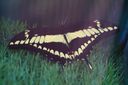
Wingspan 83–115 mm. surface of wings black with pale yellow band crossed by black ; forewings bear pale yellow spots above the and in submarginal area. Hindwings with pale yellow stripe continuous with forewing band, series of submarginal pale yellow macules, orange lunule surmounted by iridescent blue lunule at anal angle, and extended black tails. surface predominantly pale yellow; forewings similarly patterned but black areas striped with yellow; hindwings pale yellow edged with black with row of orange lunules edged with black medially. Body pale yellow and black above. Female dark form lacks band on dorsal forewings and hindwings; ventral surface predominantly black with submarginal pale yellow macules on hindwings in addition to median orange lunules; body darker.
Distribution
Mexico; Guatemala. Vagrant records: central and southern Texas, New Mexico, southern Arizona, and Kansas (rare).
Seasonality
on wing April to September. Two per year.
Diet
Larvae feed on leaves of Citrus trees. feed on flower nectar.
Host Associations
- Citrus - larval food plantlarvae feed on leaves
Life Cycle
Two per year. deposited on plants; larvae feed on leaves; presumably on host plant or nearby vegetation (specific details not documented).
Human Relevance
Occasional pest of Citrus due to larval feeding on leaves. Subject of interest to lepidopterists due to vagrancy patterns into the United States.
Similar Taxa
- Papilio thoasMember of same group (P. thoas group); similar size and general pattern but differs in specific banding details and geographic range (P. thoas more widespread in southern United States and Central America)
- Papilio cresphontesSimilar large size and yellow/black patterning; P. ornythion distinguished by continuous pale yellow stripe between forewings and hindwings and specific lunule configuration at anal angle
Sources and further reading
- BugGuide
- Wikipedia
- GBIF taxonomy match
- NCBI Taxonomy
- Catalogue of Life
- Bird droppings, snake eyes, dead leaves: Swallowtails, Papilio spp. — Bug of the Week
- Papilionoidea | Blog
- Swallowtails where art thou? Swallowtail butterflies, Papilionidae — Bug of the Week
- Parsley poacher: Black swallowtail caterpillar, Papilio polyxenes — Bug of the Week
- Swallowtail soiree - Papilio glaucus — Bug of the Week
- Swallowtail soiree – Eastern tiger swallowtail, Papilio glaucus — Bug of the Week