
Smyrna blomfildia
Fabricius, 1781
Blomfild's Beauty
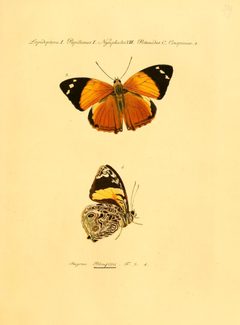
Smyrna blomfildia is a sexually dimorphic nymphalid ranging from south Texas through Mexico and Central America to Peru. Males are bright red-orange with black and white forewing markings, while females are brown. Larvae feed on nettles (Urticaceae), and consume rotting fruit. Males aggregate at mineral-rich moisture sources and defend territories.


Pronunciation
How to pronounce Smyrna blomfildia: /ˈsmɪrnə blɒmˈfɪldɪə/
These audio files are automatically generated. While they are not always 100% accurate, they are a good starting point.
Identification
Distinguished from similar nymphalines by combination of: black forewing apex with three white spots; sexually dimorphic coloration (males red-orange, females brown); and brown and tan wavy hindwing underside pattern. Male at mud puddles and mineral seepages are conspicuous behavioral cues.
Images
Habitat
Tropical forests from sea level to 1,200 m elevation. Associated with nettle plants (Urticaceae).
Distribution
South Texas and Mexico through Central America to Peru. Two recognized: S. b. blomfildia (Brazil) and S. b. datis (Mexico to Panama).
Diet
Larvae feed on Urticaceae: Urera and Urticastrum (specifically Urera baccifera). feed on rotting fruits.
Host Associations
- Urera - larval plant in Urticaceae
- Urticastrum - larval plant in Urticaceae
- Urera baccifera - larval plantspecific
Life Cycle
hatch approximately five days after laying. Females deposit eggs throughout the plant. Larvae construct chains as resting sites.
Behavior
Males are territorial and form large to imbibe mineralized moisture from mud and seepages. Females exhibit selective oviposition , preferring nettle plants without fruit to reduce attraction and larval mortality from ant .
Similar Taxa
- Vanessa speciesSimilar size and nymphaline pattern elements, but Vanessa lacks the three white forewing spots and strong in ground color
- Polygonia speciesShare angular wing margins and underside cryptic patterns, but Polygonia have notched hindwing margins and different forewing spotting