
Colobura annulata
Willmott, Constantino & Hall, 2001
new beauty
Colobura annulata, commonly known as the new beauty, is a in the Nymphalidae. The was described in 2001 by Willmott, Constantino, and Hall. It ranges from Central America into northern South America, with records extending as far north as southern California and northern Texas. Historical records from Suriname have contributed to understanding of its , including corrections to erroneous early hostplant records.
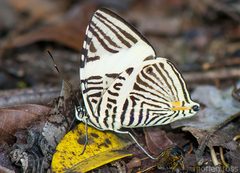
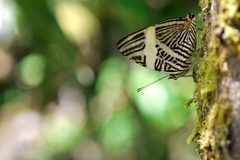
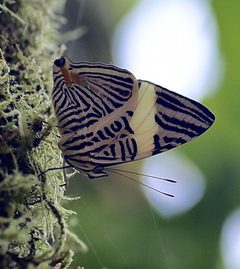
Pronunciation
How to pronounce Colobura annulata: /kəˈloʊbərə æn.jəˈlɑːtə/
These audio files are automatically generated. While they are not always 100% accurate, they are a good starting point.
Images
Distribution
Central America and northern South America. Records extend as far north as southern California and northern Texas in the United States. Documented in Colombia (Amazonas, Villavicencio) and Suriname.
Life Cycle
Last larval instar has been documented in Suriname, though specific morphological details are not provided in available sources.
Misconceptions
Sepp's 1848–1852 work "Surinaamsche Vlinders" contained an erroneous hostplant record for this based on a misidentification. This error was later rectified through comparison with H.J. Scheller's original painting, though the corrected hostplant identification is not specified in available abstracts.
More Details
Taxonomic history
The was described relatively recently in 2001, making it one of the more recently recognized species in the Colobura. Historical confusion with hostplant records suggests early naturalists had difficulty accurately documenting its .
Research gaps
Despite being a described with a documented range, published biological information remains limited. Key aspects including precise hostplant associations, complete description, and detailed await comprehensive study.
Sources and further reading
- BugGuide
- Wikipedia
- GBIF taxonomy match
- iNaturalist taxon
- NCBI Taxonomy
- Lepidoptera | Beetles In The Bush | Page 10
- Quiz Yourself: 2020 Entomology Games Questions
- May | 2010 | Beetles In The Bush | Page 2
- predator avoidance | Beetles In The Bush | Page 7
- warning coloration | Beetles In The Bush | Page 2
- Monday Moth – Trichaeta pterophorina | Beetles In The Bush
- A New Host Plant and Notes on the Last Larval Instar of Colobura annulata (Nymphalidae: Nymphalinae) in Suriname
- Erroneous Hostplant of Colobura annulata (Nymphalidae: Nymphalinae) in Sepp's Surinaamsche Vlinders [1848–1852] Rectified through Comparison with Original Painting By H. J. Scheller