
Anthanassa texana
(W.H. Edwards, 1863)
Texan crescentspot, Texan Crescent
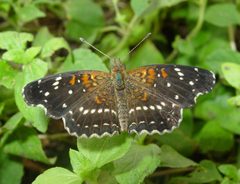
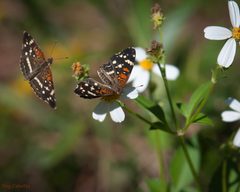
Anthanassa texana, the Texan crescentspot, is a in the Nymphalidae. It is found from Guatemala north through Mexico to the southern United States, with strays reaching as far north as South Dakota and central Nevada. The is multivoltine, with active year-round in southern Texas and the tropics, and from March to November in southern Florida and Arizona. Larvae feed on leaves of low-growing Acanthaceae plants, while adults feed on flower nectar.
Pronunciation
How to pronounce Anthanassa texana: /ænˈθænəˈsə tɛkˈsɑːnə/
These audio files are automatically generated. While they are not always 100% accurate, they are a good starting point.
Identification
Distinguished from other Anthanassa by geographic range and association with Acanthaceae plants. The two recognized (A. t. texana and A. t. seminole) differ in distribution: texana occurs in Arizona, Texas, New Mexico, Nebraska, and Mexico; seminole occurs in Florida and Georgia.
Images
Habitat
Deserts, dry gulches, open areas, streamsides, road edges, and city parks. Occupies arid and semi-arid environments from tropical to temperate zones.
Distribution
Native to North America. Core range extends from Guatemala north through Mexico to southern California, east across the southern United States to northern Florida, Georgia, and South Carolina. Strays recorded as far north as Arkansas, Missouri, Illinois, South Dakota, and central Nevada.
Seasonality
on wing March to November in southern Florida and Arizona; year-round in southern Texas and the tropics. Multiple per year.
Diet
feed on flower nectar. Larvae feed on leaves of various low-growing Acanthaceae, including Dicliptera brachiata, Justicia carnea (as Jacobinia carnea), Beloperone, Siphonoglossa, and Ruellia .
Host Associations
- Dicliptera brachiata - larval food plant
- Justicia carnea - larval food plantListed as Jacobinia carnea in sources
- Beloperone - larval food plant-level record
- Siphonoglossa - larval food plant-level record
- Ruellia - larval food plant-level record
Life Cycle
Multivoltine with several per year. Complete with , larval, pupal, and stages. Specific details of egg and pupal stages not documented in available sources.
Ecological Role
nectar feeding may contribute to pollination. Larval herbivory on Acanthaceae plants.
Human Relevance
Occasionally observed in urban environments such as city parks. No significant documented economic or agricultural impact.
Similar Taxa
- Anthanassa tulcisSimilar orange and black crescentspot pattern; distinguished by range and plant associations
- Anthanassa argenteaSimilar appearance; geographic separation and preferences aid identification
More Details
Subspecies
Two recognized: Anthanassa texana texana (Arizona, Texas, New Mexico, Nebraska, Mexico) and Anthanassa texana seminole Skinner, 1911 (Florida, Georgia).
Taxonomic history
Originally described as Melitaea texana by W.H. Edwards in 1863; later transferred to Anthanassa.