
Speyeria cybele krautwurmi
(Holland, 1931)
Great Spangled Fritillary
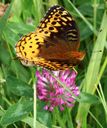
Speyeria cybele krautwurmi is a of the great spangled fritillary , recognized by Holland in 1931. It belongs to a known for visual-based navigation to patches and close ecological ties to violet plants. The subspecies occurs in northern North America, with records from the Canadian Prairie provinces and Vermont.

Pronunciation
How to pronounce Speyeria cybele krautwurmi: //spaɪˈiːriə ˈsɪbəl ˈkraʊtwɜːrmi//
These audio files are automatically generated. While they are not always 100% accurate, they are a good starting point.
Images
Distribution
Recorded from Alberta, Manitoba, and Saskatchewan in Canada, and from Vermont in the United States. Distribution data are sparse compared to the nominate .
More Details
Taxonomic Note
Speyeria cybele krautwurmi was described by Holland in 1931. It represents one of several geographically isolated within the S. cybele complex, which shows substantial regional variation across North America.
Research Context
Studies on Speyeria cybele navigation have focused primarily on the nominate or unspecified . Experimental work demonstrated that visual perception is the primary sense used for detecting and navigating to patches, with flash-blinded individuals showing dramatically reduced navigation success even at short distances.
Sources and further reading
- BugGuide
- GBIF taxonomy match
- Catalogue of Life
- UC Davis Seminar: 'Insect Conservation in an Uncertain Future' | Bug Squad
- Encyrtid Holdings | Entomology Research Museum
- Bohart Museum Butterfly Donor Chuck Hageman Leaves a Lasting Legacy | Bug Squad
- Two other orange and black butterflies: Variegated fritillary, Euptoieta claudia, and great spangled fritillary, Speyeria cybele — Bug of the Week
- The Eyes Have It: How Butterflies Navigate to Suitable Habitat
- USPS Issues Butterfly Postage Stamp