
Speyeria adiaste
(Edwards, 1864)
unsilvered fritillary, adiaste fritillary
Species Guides
1- Speyeria adiaste atossa(Atossa fritillary)
Speyeria adiaste is a California- fritillary in the Nymphalidae, distinguished from by the unsilvered hindwing spots that give it its . The occurs in two disjunct in coastal California mountains. feed on flower nectar and larvae feed on Viola species. Mark-recapture studies of the S. a. clemencei have revealed extremely limited adult and declining population trends, highlighting conservation concerns for this isolated endemic.
Pronunciation
How to pronounce Speyeria adiaste: /ˈspaɪ.ɛɹ.i.ə əˈdaɪ.əs.ti/
These audio files are automatically generated. While they are not always 100% accurate, they are a good starting point.
Identification
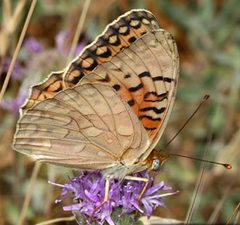
Distinguished from other Speyeria fritillaries by the unsilvered hindwing spots that barely contrast with the background color. Most have conspicuous silvery spots on the hindwing underside. The combination of reddish to brick-red upperwing coloration in males and the lack of silver spotting separates this from the great spangled fritillary (Speyeria cybele) and other similar .
Images
Appearance
Wingspan 50–61 mm. Upper side of male ranges from pale reddish tan to bright brick red; females are larger and paler than males. Dark markings are scattered and small except for a bold postmedian line. Underside ranges from pale yellow to gray. Hindwing spots are unsilvered and barely contrast with the background color—this lack of silver distinguishes it from other Speyeria .
Habitat
Coastal Californian mountains in two disjunct clusters: northern cluster in San Mateo, Santa Cruz, and Santa Clara Counties; southern cluster in Los Angeles, Kern, and Santa Barbara Counties. Specific vegetation details are not well documented.
Distribution
to California, USA. Two isolated : one in the northern Santa Cruz Mountains region (San Mateo, Santa Cruz, Santa Clara Counties) and one in the southern Coast Ranges and Transverse Ranges (Los Angeles, Kern, Santa Barbara Counties).
Diet
feed on flower nectar. Larvae feed on Viola , including Viola quercetorum.
Host Associations
- Viola quercetorum - larval plant
- Viola - larval plant-level association
Life Cycle
Lacks . have short lifespans, with males having shorter lifespans than females. Limited capacity for re- due to short adult lifespan and extremely low ability.
Behavior
is extremely limited; probability of movement greater than 5 km is less than 1.8×10⁻⁷ for both sexes. This restricted movement severely limits re- capacity for isolated .
Similar Taxa
- Speyeria cybeleGreat spangled fritillary has conspicuous silvery spots on hindwing underside; S. adiaste has unsilvered spots. S. cybele also has larger wingspan (2.25–4 inches vs. 50–61 mm) and broader geographic range across northern North America.
- Speyeria atlantisAtlantis fritillary has silvery hindwing spots and occurs in different geographic regions; distinguished by silver spotting pattern and range.
- Speyeria callippeCallippe fritillary and related occur in California but have silvery hindwing spots; distinguished by spotting pattern.
More Details
Conservation Status
The Speyeria adiaste clemencei has been studied intensively and shows declining trends from 2011–2014. Small isolated populations connectivity risks from local extinctions due to extremely limited . The subspecies Speyeria adiaste atossa is extinct (†).
Subspecies
Three recognized: S. a. adiaste (nominate), S. a. atossa (extinct), and S. a. clemencei. S. a. clemencei is the subject of most ecological research and is to the Southern Coast Ranges.
Sources and further reading
- BugGuide
- Wikipedia
- GBIF taxonomy match
- Catalogue of Life
- UC Davis Seminar: 'Insect Conservation in an Uncertain Future' | Bug Squad
- Bohart Museum Butterfly Donor Chuck Hageman Leaves a Lasting Legacy | Bug Squad
- Two other orange and black butterflies: Variegated fritillary, Euptoieta claudia, and great spangled fritillary, Speyeria cybele — Bug of the Week
- Speyeria atlantis Archives - Entomology Today
- The Eyes Have It: How Butterflies Navigate to Suitable Habitat
- USPS Issues Butterfly Postage Stamp
- Population ecology of a California endemic: Speyeria adiaste clemencei
- Life history and Ecology of Speyeria adiaste clemencei (Comstock, 1925) (Lepidoptera: Nymphalidae)