
Speyeria callippe callippe
Callippe Fritillary
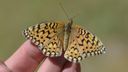
Speyeria callippe callippe is a of fritillary in the Nymphalidae. It belongs to the greater fritillary Speyeria, which includes known for their close ecological association with violets (Viola spp.) as larval plants. The subspecies is native to western North America. Related Speyeria species have been demonstrated to rely primarily on visual cues for navigation to suitable patches.


Pronunciation
How to pronounce Speyeria callippe callippe: /ˈspaɪəriə kəˈlɪpi kəˈlɪpi/
These audio files are automatically generated. While they are not always 100% accurate, they are a good starting point.
Identification
As a of Speyeria callippe, S. c. callippe would be distinguished from other S. callippe subspecies by subtle differences in wing coloration, pattern, or size. The Speyeria callippe as a whole can be distinguished from similar fritillaries by the silvery spots on the undersides of the wings. The subspecies S. c. callippe is the nominate subspecies, meaning it represents the typical form of the species.
Images
Habitat
Based on distribution records, this occurs in prairie and open woodland in the Canadian provinces of Alberta, Manitoba, and Saskatchewan. Speyeria generally require habitats containing larval plants (violets) and nectar sources for .
Distribution
Recorded from Alberta, Manitoba, and Saskatchewan in Canada. The Speyeria callippe has a broader range in western North America.
Host Associations
- Viola - larval plantBased on -level trait: Speyeria larvae feed on violets. Specific plants for this not documented in provided sources.
Behavior
Research on congeneric (Speyeria cybele and Speyeria atlantis) demonstrates that Speyeria butterflies rely primarily on visual perception for navigation to suitable patches. Flash-blinded individuals showed dramatically reduced ability to locate target habitat, even at distances as short as 20 meters. Whether S. c. callippe exhibits identical navigation has not been specifically tested.
Human Relevance
The related Speyeria callippe hagemani was named in honor of collector Chuck Hageman (1945-2021) of Yuba City, California, recognizing his extensive field research on California butterflies. Specimens of that subspecies are deposited at the Los Angeles County Museum of Natural History.
Similar Taxa
- Speyeria callippe hagemaniAnother of the same , named after collector Chuck Hageman; differs in distribution and subtle morphological traits
- Speyeria cybeleCongeneric great spangled fritillary; larger size (wingspan 2.25-4 inches), broader distribution across northern North America, similar violet-dependent
- Speyeria atlantisCongeneric Atlantis fritillary; similar size and preferences, overlapping range in some areas, both use visual navigation
More Details
Taxonomic Note
GBIF records indicate this is accepted and occurs in the Canadian prairie provinces. The Speyeria callippe contains multiple subspecies with distinct geographic ranges in western North America.
Research Context
While specific studies on S. c. callippe navigation have not been published, research on Speyeria cybele and S. atlantis by MacDonald et al. (2019) established that visual perception is the primary sense used for detection in this . Flash-blinded butterflies in that study showed only 11% success rate in reaching target islands, compared to 80-85% success at 30-40 meters for unaltered individuals.
Sources and further reading
- BugGuide
- GBIF taxonomy match
- Bohart Museum Butterfly Donor Chuck Hageman Leaves a Lasting Legacy | Bug Squad
- UC Davis Seminar: 'Insect Conservation in an Uncertain Future' | Bug Squad
- Two other orange and black butterflies: Variegated fritillary, Euptoieta claudia, and great spangled fritillary, Speyeria cybele — Bug of the Week
- Speyeria atlantis Archives - Entomology Today
- The Eyes Have It: How Butterflies Navigate to Suitable Habitat
- USPS Issues Butterfly Postage Stamp