
Boloria polaris
(Boisduval, 1828)
Polaris Fritillary
Boloria polaris is a high-arctic in the Nymphalidae, occurring across the northernmost regions of the Palearctic and Nearctic. It is notable for its extreme northern distribution, being one of only six butterfly recorded on Canada's Ellesmere Island. The species exhibits a two-year , with flying in late June to mid-July. Its larvae feed on specific tundra plants including Dryas octopetala and Vaccinium species.
Pronunciation
How to pronounce Boloria polaris: /bɔˈloʊ.ri.ə pəˈlɛrɪs/
These audio files are automatically generated. While they are not always 100% accurate, they are a good starting point.
Identification
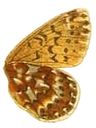
Distinguished from the similar Boloria freija by more variable coloration and more variegated hindwing underside. The black band on forewing above is heavier and more deeply sinuous proximally in B. polaris. The mother-of-pearl basal markings and silvery-toothed band on hindwing beneath are distinctive. Regular rows of submarginal spots in marginal area contrast with patterns in related .
Images
Appearance
Wingspan 32–38 mm. Forewing above with heavy, deep black band that is deeply sinuous proximally; marginal area with regular rows of submarginal spots. Hindwing beneath more variegated than related , with mother-of-pearl markings in basal area and silvery teeth on narrow band separating central from marginal area. Forewing beneath almost as distinctly marked with black as above, but paler overall. Hindwing beneath with complex pattern of light and dark markings creating variegated appearance.
Habitat
Mountain tundra near rocky areas; meadow tundra with plant availability. Occurs in high-arctic and subarctic environments with low-growing vegetation.
Distribution
Northernmost Scandinavia (Norway, Finland, Lapland), Greenland, northeastern Alaska, northern Canada (including Ellesmere Island), northeastern Russia, Chukotka. B. p. erda in central and eastern Siberia; B. p. kurentzovi in Chukotka Autonomous Okrug and Wrangel Island; B. p. polaris in northern Scandinavia, Greenland and North America.
Seasonality
fly late June to mid-July in mountain tundra ; June to August depending on location across range. In Norway, Finland and Lapland, period is July and August.
Diet
feed on nectar of Astragalus, Ledum (wild rosemary), and Dryas. Larvae feed on flowers and leaves of Dryas octopetala, Vaccinium myrtillus, Vaccinium uliginosum, and other Vaccinium .
Host Associations
- Dryas octopetala - larval food plant
- Vaccinium myrtillus - larval food plant
- Vaccinium uliginosum - larval food plant
- Vaccinium sp. - larval food plant
- Astragalus - nectar source
- Ledum - nectar source
- Dryas - nectar source
Life Cycle
Two-year development. laid singly or in groups up to 20 on caterpillar food plants; egg stage lasts just over two weeks. Caterpillars feed on flowers and leaves. Two hibernation periods under stones or moss: first after hatching (before which caterpillars do not feed), second at fourth instar. and complete the cycle in second year.
Behavior
In mountain tundra, stay near rocky areas. Females oviposit directly on larval plants. Caterpillars seek shelter under stones or moss for hibernation.
Ecological Role
function as of tundra flowering plants. Larvae are herbivores that process plant in high-arctic . Serves as potential for high-arctic ecosystem health due to specific requirements and sensitivity to environmental conditions.
Human Relevance
Subject of entomological study due to extreme northern distribution and to high-arctic conditions. One of few occurring at very high latitudes, making it of interest for studies of range limits and climate change impacts.
Similar Taxa
- Boloria freijaSimilar size and general pattern, but B. polaris has more variable coloration, more variegated hindwing beneath, heavier and more deeply sinuous black band on forewing, and distinctive mother-of-pearl and silvery markings on hindwing underside
More Details
Etymology
Specific epithet 'polaris' from Latin, referring to the polar distribution of this .
Conservation note
One of only six known from Canada's Ellesmere Island, indicating extreme specialization for high-arctic environments.
Sources and further reading
- BugGuide
- Wikipedia
- GBIF taxonomy match
- iNaturalist taxon
- NCBI Taxonomy
- Bohart Museum of Entomology's 2022 Calendar: Delightful! | Bug Squad
- Funding from ScottishPower Foundation helps to restore vital habitat to encourage thriving natural ecosystem - Buglife Blog - Buglife
- Do Managed Burns in Grasslands Benefit Butterflies?
- The great potential of citizen science - an opportunity to work together more in the name of preserving insects in 2021 - Buglife Blog - Buglife
- An Evening at Silent Valley - Buglife Blog - Buglife