
Boloria epithore
(Edwards, 1864)
Pacific Fritillary
Boloria epithore, the Pacific Fritillary, is a small to medium-sized fritillary to western North America. It is distinguished from other Boloria by its geographic restriction to the Pacific coastal region and associated mountain ranges. The species completes its in association with Viola ocellata as the sole documented larval plant. are active during a relatively brief period in early summer.
Pronunciation
How to pronounce Boloria epithore: //bəˈlɔːriə ˌɛpɪˈθɔːri//
These audio files are automatically generated. While they are not always 100% accurate, they are a good starting point.
Identification
Distinguished from other North American Boloria by its Pacific coastal distribution; B. selene (silver-bordered fritillary) and B. bellona (meadow fritillary) occur in overlapping or adjacent ranges but are primarily eastern or more widespread. B. epithore is generally smaller than many fritillaries. The combination of geographic location, size, and early summer period aids identification. Subspecific variation exists but is subtle; four are recognized based on geographic origin.
Images
Appearance
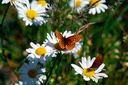
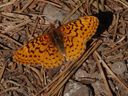
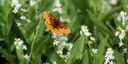
Wingspan 34–44 mm. Upperwing surfaces orange-brown with black spotting and checkered marginal patterning typical of fritillaries. Undersides of wings display silvery or pearly markings, characteristic of the . The overall size is smaller than many related fritillary .
Habitat
Associated with moist supporting the larval plant Viola ocellata. Occurs in forested and semi-open environments of the Pacific coastal region and western mountain ranges, from low elevations to subalpine zones.
Distribution
Western North America from California northward through Oregon and Washington to British Columbia and Alberta.
Seasonality
period June to July; with a single per year.
Diet
Larvae feed on Viola ocellata. nectar sources are not specifically documented in available sources.
Host Associations
- Viola ocellata - larval plantSole documented larval food plant
Life Cycle
Complete with , larva, pupa, and stages. with adults emerging in early summer. stage not explicitly documented in available sources.
Ecological Role
may contribute to pollination of native flora. As a herbivore in larval stages, links to Viola ocellata .
Human Relevance
Subject of ecological research on responses to land management practices, though most studies focus on congeneric . Not a significant agricultural pest or commercially important species.
Similar Taxa
- Boloria seleneOverlaps in some western ranges; distinguished by broader North American distribution, generally larger size, and different larval associations
- Boloria bellonaMeadow fritillary with more easterly and widespread distribution; differs in preference and plant use
- Boloria charicleaArctic and alpine fritillary with more northerly distribution; occurs at higher latitudes and elevations than B. epithore
More Details
Subspecies
Four recognized: B. e. epithore (California, nominate), B. e. chermocki (Oregon), B. e. sierra (California), and B. e. uslui (British Columbia). Differentiated by geographic origin rather than pronounced morphological divergence.
Sources and further reading
- BugGuide
- Wikipedia
- GBIF taxonomy match
- iNaturalist taxon
- NCBI Taxonomy
- Catalogue of Life
- Funding from ScottishPower Foundation helps to restore vital habitat to encourage thriving natural ecosystem - Buglife Blog - Buglife
- Do Managed Burns in Grasslands Benefit Butterflies?
- An Evening at Silent Valley - Buglife Blog - Buglife