
Habrodais grunus
(Boisduval, 1852)
Golden Hairstreak
The golden is a small North American in the Lycaenidae. It is strongly associated with oak and displays unusual activity patterns, being most active during dawn and dusk rather than midday. The has a single and shows high fidelity to specific oak plants for larval development.
Pronunciation
How to pronounce Habrodais grunus: //hæbˈroʊdaɪs ˈɡruːnəs//
These audio files are automatically generated. While they are not always 100% accurate, they are a good starting point.
Identification
Distinguished from other hairstreaks (Satyrium, Callophrys) by its golden-orange coloration rather than gray, brown, or blue tones. The activity pattern separates it from most sympatric lycaenids. The combination of oak woodland , small size, and golden upperside is diagnostic within its range. Similar Satyrium lack the bright golden ground color and have different plant associations.
Images
Appearance
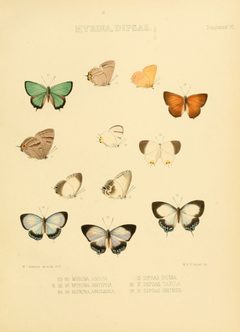
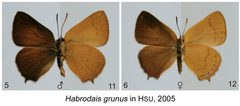
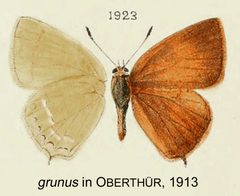
Small with wingspan 25–32 mm. wing surfaces are golden-orange with dark margins. surfaces show fine gray-brown striations with a thin, tail-like projection on the hindwing. The overall coloration provides camouflage when wings are closed at rest.
Habitat
Oak woodland, canyon slopes, and mountain ridges. Occupies elevations where evergreen oaks (especially canyon live oak and tanbark oak) occur. Requires shaded resting sites within forested areas.
Distribution
Western North America from southern Oregon through California to southern Arizona, extending into Mexico. Three recognized: H. g. grunus (California), H. g. herri (California, Oregon, Idaho), and H. g. lorquini (California).
Seasonality
active June to September. Single per year (). Peak activity occurs in early morning and evening hours.
Diet
feed on moisture from various sources including damp soil and possibly honeydew or other plant exudates. Larvae are obligate feeders on young leaves of specific Fagaceae: canyon live oak (Quercus chrysolepis), huckleberry oak (Quercus vaccinifolia), tanbark oak (Notholithocarpus densiflorus, formerly Lithocarpus densiflorus), and golden chinquapin (Chrysolepis chrysophylla).
Host Associations
- Quercus chrysolepis - larval canyon live oak
- Quercus vaccinifolia - larval huckleberry oak
- Notholithocarpus densiflorus - larval tanbark oak; formerly Lithocarpus densiflorus
- Chrysolepis chrysophylla - larval golden chinquapin
Life Cycle
with one annually. Larvae feed on young oak leaves. occurs in leaf litter or soil. emerge in summer and persist for several months. stage not explicitly documented in sources.
Behavior
Primarily : most active during early morning and evening hours. spend midday resting in shaded areas with wings closed, relying on cryptic coloration. This activity pattern reduces exposure to heat and .
Ecological Role
Larval herbivore on oak foliage; contributes to nutrient cycling in oak woodland . feeding on honeydew or exudates may incidentally affect -tending dynamics, though this relationship is not well documented.
Human Relevance
Subject of interest to enthusiasts due to its unusual activity pattern and golden coloration. Not considered economically significant. trends likely tied to oak woodland conservation status.
Similar Taxa
- Satyrium sylvinusSylvan overlaps in range and but has gray-brown coloration and uses willows (Salix) as larval rather than oaks.
- Callophrys augustinusBrown elfin is similar in size but has brown coloration, activity, and uses heath (Ericaceae) .
- Habrodais poodiaeRelated congeneric with similar ; distinguished by distribution and subtle morphological differences.
More Details
Taxonomic Note
Larval Lithocarpus densiflorus has been reclassified to Notholithocarpus densiflorus based on molecular phylogenetic studies; older literature uses the former name.
Activity Pattern
The is unusual among North American Lycaenidae and represents an to hot, dry summer conditions in its oak woodland .