
Habrodais
Scudder, 1876
Species Guides
1- Habrodais grunus(Golden Hairstreak)
Habrodais is a of small butterflies in the Lycaenidae, containing two restricted to western North America. The genus was established by Scudder in 1876. Both species are associated with oak woodlands and have specialized ecological relationships with their plants.
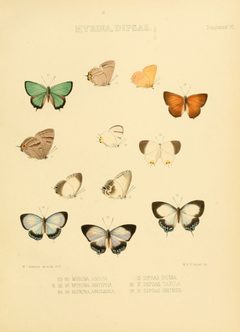
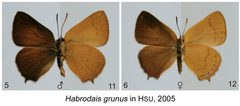
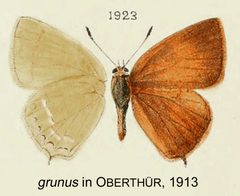
Pronunciation
How to pronounce Habrodais: /hæbˈroʊdaɪs/
These audio files are automatically generated. While they are not always 100% accurate, they are a good starting point.
Identification
Habrodais are small lycaenid butterflies with relatively rounded wings. They can be distinguished from related by their Nearctic distribution and association with oak . The two species, H. grunus and H. poodiae, differ in geographic range and subtle wing pattern differences, with H. poodiae being more restricted to southern California and Baja California.
Images
Habitat
Oak woodlands and oak-associated in western North America. The shows strong fidelity to Quercus-dominated .
Distribution
Western North America. H. grunus ranges from British Columbia through Washington, Oregon, and California to Baja California. H. poodiae is restricted to southern California and Baja California.
Diet
Larvae feed on oaks (Quercus ). Specific associations vary by species and region.
Host Associations
- Quercus - larval plant-level association; specific oak used varies by region and species
Life Cycle
Complete with , larva, pupa, and stages. Larvae are known to have associations with ants (myrmecophily), a common trait in Lycaenidae, though specific details for Habrodais are not well documented.
Ecological Role
of flowers in oak woodland . Larval stage contributes to nutrient cycling and serves as prey for and . associations may provide protection to larvae.
Human Relevance
Of interest to lepidopterists and conservation biologists due to restricted ranges and specificity. Potential for oak woodland health.
Similar Taxa
- SatyriumSimilar small lycaenid butterflies with rounded wings and association with woody plants; Satyrium often have more pronounced tail-like projections on hindwings and different plant associations
- CallophrysRelated lycaenid with green coloration in many ; Habrodais lacks the metallic green scaling typical of many Callophrys and has different wing shape
More Details
Taxonomic history
The was described by Samuel Hubbard Scudder in 1876. H. poodiae was not described until 1982, making it a relatively recently recognized . The specific epithet 'poodiae' honors Dorothy P. Poodle, who contributed to the study of California butterflies.
Conservation status
H. poodiae has a very restricted range and may be vulnerable to loss from oak woodland degradation and urbanization in southern California. H. grunus has a broader distribution but still depends on intact oak .