
Calycopis isobeon
(Butler & Druce, 1872)
dusky-blue groundstreak
Calycopis isobeon, the dusky-blue groundstreak, is a small in the Lycaenidae. It ranges from Venezuela northward through Central America and Mexico to central Texas. The is extremely similar in appearance to the red-banded hairstreak (Calycopis cecrops), and the two are sometimes treated as due to their close morphological resemblance.
Pronunciation
How to pronounce Calycopis isobeon: /ˌkælɪˈkoʊpɪs ˈɪsəˌbiːɒn/
These audio files are automatically generated. While they are not always 100% accurate, they are a good starting point.
Identification
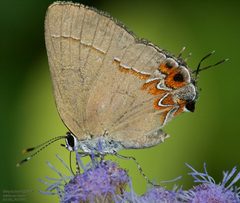
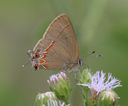
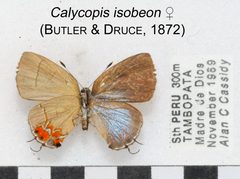
Distinguished from the very similar Calycopis cecrops (red-banded ) by subtle differences in wing pattern. The two are so similar that they are sometimes treated as . Upper wing surfaces are dark with metallic blue on the hindwings. Underside pattern details and the shape of the black marking within the orange spot at the hindwing margin may help separate the species, with C. isobeon having a more pointed, narrow black triangle in this position compared to the broader, blunter mark in C. cecrops, though variation exists.
Images
Distribution
Native to the Americas, ranging from Venezuela through Central America and Mexico to central Texas in the southern United States.
Similar Taxa
- Calycopis cecropsExtremely similar in appearance; sometimes treated as . Distinguished by subtle differences in the shape of the black marking within the orange hindwing spot, with C. cecrops having a broader, blunter mark.
- Calycopis origoAnother similar Calycopis that may be confused with C. isobeon; identification requires examination of wing pattern details.
Sources and further reading
- BugGuide
- Wikipedia
- GBIF taxonomy match
- iNaturalist taxon
- NCBI Taxonomy
- Catalogue of Life
- Brazil Bugs #2 | Beetles In The Bush
- Coccinelidae | Beetles In The Bush
- Sarcophagidae | Beetles In The Bush
- Brazil Bugs | Beetles In The Bush | Page 2
- Hymenoptera | Beetles In The Bush | Page 8
- Lepidoptera | Beetles In The Bush | Page 8