
Calycopis
Scudder, 1876
groundstreaks, hairstreaks
Species Guides
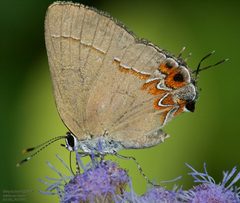
2- Calycopis cecrops(Red-banded Hairstreak)
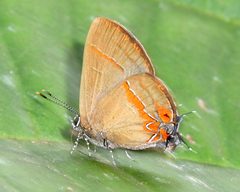
- Calycopis isobeon(dusky-blue groundstreak)
Calycopis is a of small butterflies in the Lycaenidae, commonly known as groundstreaks or hairstreaks. The genus contains numerous distributed across the Neotropical and Nearctic realms. A controversial taxonomic revision by Kurt Johnson in 1991 proposed extensive splitting of the genus, but most modern authors reject these changes as unjustified. Species within Calycopis are typically associated with forest edges and disturbed where their larval plants occur.
Pronunciation
How to pronounce Calycopis: /kæˈlaɪkəˌpɪs/
These audio files are automatically generated. While they are not always 100% accurate, they are a good starting point.
Identification
Calycopis are small lycaenid butterflies with characteristic : reduced forelegs, slender bodies, and often possessing tail-like extensions on the hindwings. The is distinguished from similar hairstreak genera by genitalic characters and wing pattern details, particularly the configuration of markings on the hindwing underside. Species-level identification requires examination of wing pattern elements including the shape and extent of orange marginal bands, the presence and form of dark basal triangles, and the configuration of metallic blue scaling on the upperside of males. The similar genus Strymon differs in details of the male genitalia and wing venation.
Images
Habitat
Calycopis occupy diverse including tropical and subtropical forests, forest edges, clearings, and disturbed areas. They are frequently encountered in secondary growth vegetation and along forest margins where their larval plants—various species of Asteraceae and other —are present. Some species have adapted to anthropogenic habitats including gardens and agricultural areas with suitable flowering plants.
Distribution
The Calycopis is distributed from the southern United States through Mexico, Central America, and throughout South America, with the majority of occurring in the . Several species extend into the , particularly in the southern United States. The genus reaches its greatest diversity in tropical South America.
Behavior
are rapid, erratic fliers that typically remain close to the ground or vegetation. They frequently perch with wings closed, displaying the cryptic undersides. When disturbed, they often fly short distances and resettle, sometimes repeatedly, making them challenging to observe and photograph. Males may establish territories and engage in aerial pursuits of other butterflies. The tail-like hindwing extensions, when present, are thought to function in deflecting attacks away from vital body parts.
Ecological Role
As , Calycopis serve as of various flowering plants. The larvae function as herbivores, consuming leaf tissue of their plants. Their interactions with ants, if present, have not been well documented for most species. The contributes to local diversity in Neotropical and southern Nearctic .
Human Relevance
Calycopis are of interest to collectors and photographers due to their diversity and the challenges of identification. Some species, such as the red-banded hairstreak (Calycopis cecrops), are familiar components of North American butterfly faunas. The has been subject to extensive taxonomic study and debate, making it significant in discussions of lycaenid .
Similar Taxa
- StrymonBoth contain small butterflies with similar wing shapes and patterns. Strymon differs in male genitalic structure and typically lacks the distinctive groundstreak wing pattern elements seen in Calycopis.
- MinistrymonAnother with overlapping distribution and similar size. Ministrymon often have more reduced wing markings and different hindwing tail configurations.
- RekoaFormerly included within Calycopis, this was separated by some authors but its status remains debated. Rekoa typically show different wing pattern arrangements, particularly on the hindwing underside.
More Details
Taxonomic History
The Calycopis has undergone extensive taxonomic revision. In 1991, Kurt Johnson proposed splitting the genus into numerous smaller genera based on subtle morphological differences. Most subsequent authors have rejected this splitting as unjustified, maintaining a more inclusive concept of Calycopis. The resulting taxonomic instability has complicated identification and biogeographic analysis.
Notable Species
Calycopis cecrops, the red-banded hairstreak, is among the most widespread and frequently encountered , ranging from the southern United States through Central America. Calycopis isobeon and C. pisis are additional well-documented species with broad Neotropical distributions.
Sources and further reading
- BugGuide
- Wikipedia
- GBIF taxonomy match
- iNaturalist taxon
- NCBI Taxonomy
- Catalogue of Life
- Brazil Bugs #2 | Beetles In The Bush
- Coccinelidae | Beetles In The Bush
- Sarcophagidae | Beetles In The Bush
- Brazil Bugs | Beetles In The Bush | Page 2
- Hymenoptera | Beetles In The Bush | Page 8
- Lepidoptera | Beetles In The Bush | Page 8