
Calycopis cecrops
(Fabricius, 1793)
Red-banded Hairstreak
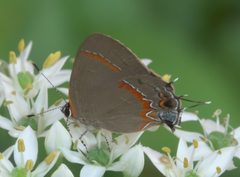
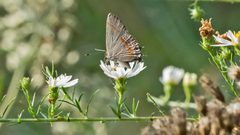
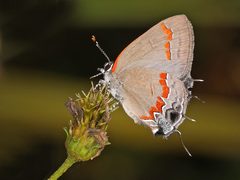
Calycopis cecrops, commonly known as the red-banded , is a small native to the southeastern United States. have a wingspan of 23–32 mm and are characterized by grayish underwings with a distinctive red band. The has been observed feeding on fallen leaves of sumac species and other trees. It is typically found in coastal areas and open .
Pronunciation
How to pronounce Calycopis cecrops: //kæˈlɪkəpɪs ˈsiːˌkrɒps//
These audio files are automatically generated. While they are not always 100% accurate, they are a good starting point.
Identification
The red-banded is distinguished from other Calycopis by the presence of a prominent red band on the underside of the hindwing. The upper surface of the wings is dark with limited patterning visible in . The hindwing bears a small tail-like projection typical of hairstreak butterflies. The species is smaller than many other hairstreaks in the region, with a wingspan of 23–32 mm.
Images
Habitat
Coastal areas and open in the southeastern United States.
Distribution
Southeastern United States. Distribution records indicate presence in North America, including Saskatchewan, Canada and Vermont, United States.
Diet
Larvae feed on fallen leaves of sumac (Rhus spp.) and other trees.
Behavior
are rapid, erratic fliers that frequently perch with wings closed, displaying the characteristic red band on the underwing. When disturbed, they have been observed to fly to nearby vegetation rather than remaining in place.
Similar Taxa
- Calycopis origoSimilar grayish underwing coloration, but C. origo lacks the distinct red band present in C. cecrops and has different pattern elements on the hindwing.
- Calycopis cauloniaOverlapping range and similar size; C. caulonia has a broader, blunter black triangle within the orange mark on the hindwing underside, whereas C. cecrops has a more pointed, narrow black triangle.
Sources and further reading
- BugGuide
- GBIF taxonomy match
- iNaturalist taxon
- NCBI Taxonomy
- Catalogue of Life
- A season of silk moths continues with Cecropia moth, Hyalophora cecropia — Bug of the Week
- Brazil Bugs #2 | Beetles In The Bush
- Coccinelidae | Beetles In The Bush
- Sarcophagidae | Beetles In The Bush
- Brazil Bugs | Beetles In The Bush | Page 2
- Hymenoptera | Beetles In The Bush | Page 8