
Callophrys irus irus
Frosted Elfin
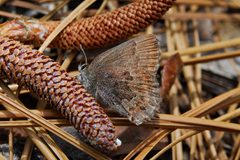
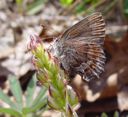
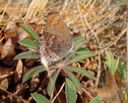
Callophrys irus irus is the nominate of the frosted elfin , a rare Lycaenid with a historical range spanning from Ontario to Florida and west to Texas and Wisconsin. Genetic studies have found no evidence that this subspecies is genetically distinct from other , including the historically recognized C. i. arsace. The inhabits fire-maintained pine barren and has experienced significant population declines due to habitat loss and fragmentation. Conservation efforts focus on managing habitat patch area and plant abundance to improve occupancy probability.
Pronunciation
How to pronounce Callophrys irus irus: /ˈkæl əˌfrɪs ˈaɪ rəs ˈaɪ rəs/
These audio files are automatically generated. While they are not always 100% accurate, they are a good starting point.
Images
Habitat
Occupies fire-maintained pine barren . Field studies indicate that total habitat patch area is the most significant predictor of occupancy, with a occupied patch size of 1.31 hectares. Habitat area across surveyed sites ranged from 0.0015 to 10 hectares. Occupancy is predicted to increase by approximately 7% for each additional hectare of habitat area available. plant abundance correlates strongly with habitat area.
Distribution
Historical range extends from Ontario to Florida, and west to Texas and Wisconsin. Distribution records include Vermont and other eastern United States locations. are isolated and many have been presumed extirpated due to anthropogenic pressures.
Host Associations
- Baptisia spp. - larval plantUsed for oviposition and larval feeding; vary in plant use across range
- Lupinus spp. - larval plantAlternative plant used by some ; no genetic differentiation observed between indigo-specialized and lupine-specialized populations
Life Cycle
Pupae are formed primarily in leaf litter, at the soil surface, or just below it. depth varies among individuals; experimental studies found that pupae buried at 1.75 cm below ground had 60% survival rate following experimental fires, while those at 0.75 cm depth had no survival. Most surviving pupae (17 of 18) successfully eclosed the following year. The spends the majority of the year in the pupal stage.
Human Relevance
Subject to conservation concern due to rarity and loss. Research supports management recommendations including maintaining larger habitat patches with abundant plants, using rotational burn schedules, and creating fire refugia to ensure long-term persistence. or reintroduction efforts may be viable given the lack of strong genetic structure across the range.
Similar Taxa
- Callophrys irus hadrosAnother of frosted elfin, distributed in Arkansas and the Ozark region
- Callophrys irus arsaceHistorically recognized from coastal Carolinas and Virginia; genetic studies found no evidence of distinctiveness from C. i. irus; no extant found in recent surveys
Sources and further reading
- BugGuide
- GBIF taxonomy match
- iNaturalist taxon
- Bug Eric: Year-end Wrap-up
- Bug Eric: City Nature Challenge 2023 Recap
- Life History Observations of Callophrys irus (Family: Lycaenidae) in North Florida, USA
- Conservation genetics and habitat occupancy modeling for the frosted elfin butterfly, Callophrys irus
- Distribution and Habitat Preferences of a Frosted Elfin Subspecies (Callophrys irus hadros, Lycaenidae) in Arkansas
- Pupae survival following fire in the frosted elfin ( Callophrys irus )
- Dispersal, population size, and reproduction in a fire-maintained frosted elfin (Callophrys irus) metapopulation
- Habitat characteristics of adult frosted elfins (Callophrys irus) in sandplain communities of southeastern Massachusetts, USA
- The effect of soil moisture and ambient temperature on pupation depth for the imperiled Callophrys irus
- Microhabitat use by larvae and females of a rare barrens butterfly, frosted elfin (Callophrys irus)