
Atlides halesus
(Cramer, 1779)
Great Purple Hairstreak, Great Blue Hairstreak
Atlides halesus is a striking in the Lycaenidae, notable for its misnomer of a —despite being called the "Great Purple ," it displays iridescent blue coloration rather than purple. This Neotropical ranges from warm-temperate and subtropical North America southward nearly to the Isthmus of Panama. The larvae feed exclusively on mistletoe species (Phoradendron spp.), making this dependent on the presence of these parasitic plants. are known for , where males defend perches on elevated terrain to intercept females.
Pronunciation
How to pronounce Atlides halesus: //ætˈlaɪdiːz ˈhæliːsəs//
These audio files are automatically generated. While they are not always 100% accurate, they are a good starting point.
Identification
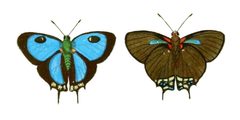
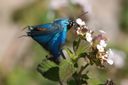
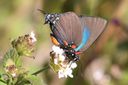
Distinguished from similar hairstreaks by its large size within the Lycaenidae and brilliant iridescent blue wing surfaces. The "Great Purple " is misleading as no purple coloration is present; the appears blue to blue-green depending on light angle. Typical hairstreak characteristics include thin tail-like projections on the hindwings and small spots near these tails. The is larger than the related Gray Hairstreak (Strymon melinus), with which it may co-occur.
Images
Habitat
Occurs in valley and foothill riparian forests, older urban neighborhoods with well-developed tree , and foothill woodland. Found from sea level to approximately 5,000 feet elevation wherever mistletoes occur. In desert regions, associated with riparian corridors and areas supporting mistletoe-infested trees.
Distribution
North American range includes warm-temperate and subtropical regions from the southern United States southward almost to the Isthmus of Panama. Within the U.S., occurs in California (Sacramento Valley, Central Valley, foothill regions), Arizona, Texas, and other southern states. originated from the Colony of Virginia. The is continuously distributed through Mexico and Central America.
Seasonality
Breeds continuously in warm weather. In the Sacramento Valley, most abundant in June and September, though individuals may appear any time from March through October. At higher elevations such as Sierra Valley, active from June through October. Activity pattern tied to temperature rather than fixed calendar dates.
Diet
Larvae feed exclusively on mistletoes ( Santalaceae, Phoradendron), including P. villosum (small-leaved oak mistletoe), P. macrophyllum (large-leaved mistletoe on various broadleaf trees), and P. juniperinum (juniper mistletoe). visit flowers for nectar, including dogbane (Apocynum), milkweeds (Asclepias), goldenrods (Solidago), California buckeye (Aesculus californica), members of the carrot family (Apiaceae), and peppergrass (Lepidium latifolium). Also attracted to and Zinnias in garden settings.
Host Associations
- Phoradendron villosum - larval food plantSmall-leaved mistletoe restricted to oaks
- Phoradendron macrophyllum - larval food plantLarge-leaved mistletoe on broadleaf trees other than oaks, occasionally shrubs including poison oak
- Phoradendron juniperinum - larval food plantJuniper and cypress mistletoe; at Sierra Valley and serpentine areas with MacNab and Sargent cypresses
Life Cycle
Continuous breeding in warm weather. Pupae form in litter beneath mistletoe-infested trees, though pupae are frequently parasitized. No reported; time appears to vary with temperature and plant availability.
Behavior
Males exhibit , flying to highest points in the landscape (mountains, buttes, hills) and defending perches on boulders, shrubs, or trees with optimal visibility for detecting approaching females. Competing males are actively driven away from these territories. This territorial defense is characteristic of the Lycaenidae . are strong fliers capable of covering significant distances to locate hilltop sites.
Ecological Role
Serves as a herbivore tightly linked to mistletoe . As a conspicuous, large-bodied , may contribute to pollination of nectar sources. The ' dependence on mistletoe makes it a potential indicator of health in riparian and woodland where mistletoes occur.
Human Relevance
Subject of long-term monitoring by researchers, notably Art Shapiro's 52+ year monitoring program in Central California. The ' disappearance from areas where mistletoe has been eradicated or declined (as observed in Davis, California in 2023) highlights concerns about urban modification and potential local extirpation. Frequently photographed by naturalists due to its brilliant coloration despite being challenging to approach closely.
Similar Taxa
- Strymon melinusGray Hairstreak shares Lycaenidae and perch-defense , but is smaller, has gray rather than iridescent blue coloration, and uses different plants
- Other Atlides speciesNeotropical may overlap in southern parts of range; distinguished by distribution and subtle wing pattern differences
Misconceptions
The "Great Purple " is erroneous; the displays iridescent blue coloration with no purple visible. This misnomer has persisted in entomological literature and popular references despite being noted as incorrect by multiple experts.
More Details
Population Vulnerability
Local are vulnerable to mistletoe removal. In December 2023, researcher Art Shapiro documented apparent local extirpation in Davis, California following disappearance of mistletoe from previously infested trees, with only two heavily infested trees located in extensive searching. This suggests the can disappear rapidly when plants are eliminated.
Hilltopping Ecology
The of males creates predictable congregation points that facilitate mating but may also increase vulnerability to and environmental stochasticity at these exposed sites.
Historical Context
was shipped to Europe from the Colony of Virginia around the time of the United States Declaration of Independence, making this one of the earlier North American described in European scientific literature.