
Atlides
Hübner, 1819
Great Purple Hairstreak (for A. halesus)
Species Guides
1- Atlides halesus(Great Purple Hairstreak)
Atlides is a of gossamer-winged butterflies in the Lycaenidae, Theclinae, tribe Eumaeini. The genus contains approximately 18 named plus 5 or more undescribed species distributed across the Americas from the southern United States to Argentina. The most well-known species, Atlides halesus (great purple ), is notable for its iridescent blue coloration—despite its containing "purple"—and its exclusive larval association with mistletoe species (Phoradendron). Males of at least some species possess androconial producing distinctive volatile compounds; A. polybe males emit a grape-like aroma from methyl anthranilate, the first such compound reported in Papilionoidea.
Pronunciation
How to pronounce Atlides: /ˈæt.lɪ.deɪz/
These audio files are automatically generated. While they are not always 100% accurate, they are a good starting point.
Identification
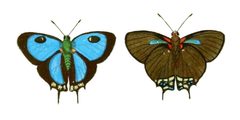
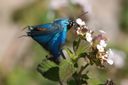
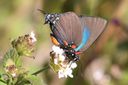
Members of the Atlides Section (including Atlides) are characterized by a hindwing cleft anal lobe that is lacking in other Eumaeini except some Panthiades . Atlides species are small butterflies. Atlides halesus is distinguished by its iridescent blue upperwing surfaces with orange marginal spots and two slender tail-like projections on the hindwings; the underside is gray with orange and blue spots near the tail bases. The "great purple " is misleading as no purple is present—the coloration is iridescent blue.
Images
Habitat
Atlides occur in diverse across their broad range. Atlides halesus is most common in valley and foothill riparian forest, older urban neighborhoods with well-developed tree , and foothill woodland from sea level to approximately 5000 feet elevation. The occurs wherever mistletoe plants are present, including oak woodlands and areas with cottonwoods and other broadleaf trees supporting Phoradendron species.
Distribution
Widespread in the Americas from the southern United States (including California, Texas, and Arizona) south through Mexico and Central America to Argentina. Individual have more restricted ranges: A. halesus occurs from the U.S. and Mexico south to Guatemala and Rica; A. polybe ranges from Mexico to southern Brazil; A. atys and A. bacis occur from Costa Rica to southern Brazil.
Seasonality
Atlides halesus breeds continuously in warm weather from March to October in California's Central Valley and foothills, and from June to October at higher elevations such as Sierra Valley. Peak abundance in the Sacramento Valley typically occurs in June and September. Activity patterns for other vary with local climate conditions across the 's broad latitudinal range.
Host Associations
- Phoradendron villosum - larval Small-leaved mistletoe restricted to oaks; for Atlides halesus
- Phoradendron macrophyllum - larval Large-leaved mistletoe found on broadleaf trees other than oaks; for Atlides halesus
- Phoradendron juniperinum - larval Found on junipers and cypresses; for Atlides halesus at Sierra Valley and on serpentine soils
Life Cycle
Continuous breeding occurs in warm weather where climate permits. Pupae can be found in litter beneath mistletoe-infested trees, though rates are typically high.
Behavior
Males of Atlides halesus exhibit , flying to elevated terrain features such as ridges or hilltops to defend perches and seek females. Males of A. polybe possess specialized androconial on the wings that produce a distinctive grape-like aroma; chemical analysis identified methyl anthranilate as the volatile compound, likely functioning as a and possibly in deterrence. The specialized scales in A. polybe exhibit a unique tortuous, fibrillar internal structure combined with a windowed exterior that promotes heat retention, potentially ensuring steady release.
Ecological Role
As herbivores, larvae feed exclusively on mistletoe (Phoradendron ), making the dependent on these hemiparasitic plants. serve as and are documented visiting diverse nectar sources including dogbane, milkweed, goldenrod, California buckeye, members of Apiaceae, and peppergrass.
Human Relevance
Atlides halesus is valued by enthusiasts and photographers for its striking iridescent blue appearance—contrasting with its misleading . The has been monitored for decades in California by researchers including Art Shapiro, providing long-term data. Local declines in mistletoe abundance in some areas (e.g., Davis, California in 2023-2024) have raised concerns about potential local extirpation of A. halesus populations. The grape-like scent chemistry of A. polybe has been studied for its unique methyl anthranilate composition, representing the first report of this compound in Papilionoidea.
Similar Taxa
- Strymon melinus (Gray Hairstreak)Also a member of tribe Eumaeini with similar size and general ; both hilltop and defend perches. Distinguished by gray coloration and lack of iridescent blue in S. melinus, and by different plant associations.
- Other Eumaeini genera (Theritas, Arcas, Lucilda, Pseudolycaena, Brangas, Denivia)These share the hindwing cleft anal lobe synapomorphy that defines the Atlides Section. Distinguished by specific morphological characters and, where known, different associations and distribution patterns.
Misconceptions
The "great purple " for A. halesus is a persistent misnomer—no purple coloration exists on this . The is iridescent blue above with orange marginal spots. The name likely arose from historical color perception or descriptive traditions rather than accurate observation.
More Details
Nomenclatural note
The Atlides is part of the monophyletic Atlides Section of tribe Eumaeini, characterized by the hindwing cleft anal lobe synapomorphy. Recent taxonomic work has clarified relationships among included genera and established new synonyms and combinations. A proposal to separate A. thargelia as the genus "Riojana" was rejected as a under ICZN Article 13.1 due to lack of appropriate genus description.
Chemical ecology
Atlides polybe represents the first Theclinae with chemically investigated androconial secretions. The compound methyl anthranilate, used commercially as grape flavoring, produces the species' characteristic scent. This discovery expands understanding of evolution in butterflies and demonstrates novel thermal management structures in lepidopteran .
Sources and further reading
- BugGuide
- Wikipedia
- GBIF taxonomy match
- iNaturalist taxon
- NCBI Taxonomy
- Catalogue of Life
- The Missing Mistletoe and the Non-Purple Great Purple Hairstreak Butterfly | Bug Squad
- A Close Call | Bug Squad
- Bug Eric: Spring (Butterfly) Beauties
- Bug Eric: Hilltopping
- Acanthaceae | Beetles In The Bush
- Specialized scales in Atlides polybe butterfly thermally insulate pheromones
- Phylogenetic Classification of the Atlides Section of the Eumaeini (Lepidoptera, Lycaenidae)
- Uncovering the grape-like aroma of Atlides polybe (Linnaeus, 1763) (Lepidoptera: Lycaenidae, Theclinae)