
Plebejus anna
(W.H. Edwards, 1861)
Anna's blue
Plebejus anna, commonly known as Anna's blue, is a North American in the Lycaenidae. It was formerly considered with the northern blue (Plebejus idas) but is now recognized as a distinct species. The butterfly exhibits in wing coloration and is , with active during summer months.
Pronunciation
How to pronounce Plebejus anna: /ˈplɛbɛjus ˈænə/
These audio files are automatically generated. While they are not always 100% accurate, they are a good starting point.
Identification
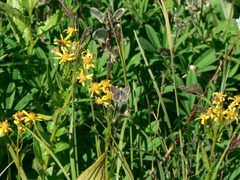
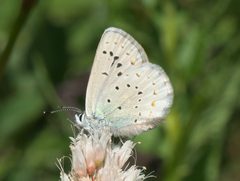
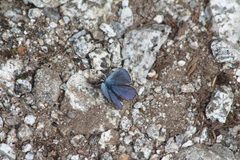
Anna's blue can be distinguished from the similar Melissa blue (Plebejus idas, formerly considered ) by the following features: males are more bluish-white with white wing outlines; females have less developed orange submarginal bands that may be completely absent, whereas Melissa blue females typically show more prominent orange bands. The also differs from other blues in its specific wing pattern and coloration details.
Images
Appearance
Males have bluish-white upper wings with white marginal outlines. Females have brown wings with orange submarginal bands that are often less developed than in similar and may be completely absent; wings have whitish outlines. Both sexes are small butterflies typical of the 'blue' group.
Habitat
include areas supporting larval plants: blueberry and other heaths (Ericaceae), and legumes. Specific habitat structure not detailed in sources.
Distribution
Found in North America. Precise range boundaries not specified in available sources.
Seasonality
; active during summer (one per year).
Diet
Larval food plants: blueberry and other heaths (Ericaceae), and legumes. feeding habits not specified.
Host Associations
- blueberry - larval food plantEricaceae
- heaths - larval food plantEricaceae
- legumes - larval food plantFabaceae
Life Cycle
Complete with one per year (). Specific details of , larval, pupal stages and duration not documented in sources.
Behavior
occurs during summer months. Specific behavioral observations not documented in sources.
Ecological Role
Herbivore as larva; as (inferred from traits, not explicitly documented). Specific ecological interactions not detailed.
Human Relevance
Subject of taxonomic study; formerly confused with Plebejus idas. MONA/Hodges number 4374.1.
Similar Taxa
- Plebejus idasFormerly considered ; females differ in having more prominent orange submarginal bands, males less bluish-white
- Plebejus melissaSimilar appearance; referred to as 'Melissa blue' in some sources, though taxonomic relationship requires clarification
Misconceptions
Formerly treated as one with the northern blue (Plebejus idas); now recognized as distinct based on morphological differences.
More Details
Taxonomic history
Originally described as Lycaena anna by W.H. Edwards in 1861. Transferred to Plebejus. Long treated as with Plebejus idas before recognition as distinct .
Subspecies
Six recognized: P. a. anna, P. a. azureus, P. a. benwarner, P. a. lotis, P. a. ricei, P. a. vancouverensis.
Sources and further reading
- BugGuide
- Wikipedia
- GBIF taxonomy match
- iNaturalist taxon
- NCBI Taxonomy
- A Dragonfly to Behold: Within an Arm's Reach | Bug Squad
- Matt Forister: Melissa Blue Butterfly and Colonization of Alfalfa | Bug Squad
- Meet Two Outstanding Entomology Graduating Seniors at UC Davis | Bug Squad
- Famous Female Entomologists Part 2: Anna Botsford Comstock
- Scientific Annals of the Danube Delta Institute | Blog
- Bug Eric: Mother (Nature's) Day in Madera Canyon