
Plebejus idas
(Linnaeus, 1761)
Idas blue, northern blue
Species Guides
3- Plebejus idas aster(Idas Blue)
- Plebejus idas empetri(Crowberry Blue)
- Plebejus idas nabokovi(Nabokov's Blue)
Plebejus idas is a small blue in the Lycaenidae, widely distributed across the Palearctic and Nearctic realms. Males display iridescent blue upper wings, while females are brown with orange submarginal spots. The exhibits notable geographic variation in its ecological relationships, including facultative versus obligate myrmecophily. The critically endangered P. idas lotis (lotis blue butterfly), native to coastal California, is believed extinct since 1994.
Pronunciation
How to pronounce Plebejus idas: //ˈplɛbɛ.jus ˈiː.das//
These audio files are automatically generated. While they are not always 100% accurate, they are a good starting point.
Identification
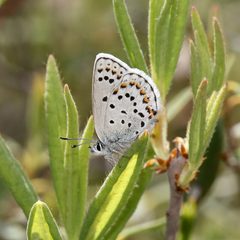
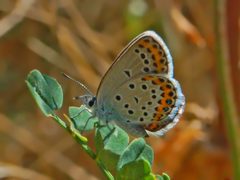
Distinguished from similar Plebejus argus (silver-studded blue) by absence of hook on male forelegs. Differs from Plebejus argyrognomon (Reverdin's blue) in wing pattern details. Variable in color and markings; examination of male foreleg structure or genitalia may be required for definitive identification where ranges overlap.
Images
Appearance
Wingspan 17–28 mm. Upperside of male wings iridescent blue; female upperside brown with orange submarginal spots. Underface greyish with black spots, thin black line and small dots along outer margin; large orange band with blue spots present along margins. Forelegs of male lack hook present in Plebejus argus.
Habitat
Grassy flowery areas, mixed evergreen forests, and wet meadows from lowlands to alpine zones. Elevation range 200–2,100 m. In northern Upper Rhine Valley, Germany, inhabits dry heathland with Cytisus scoparius patches.
Distribution
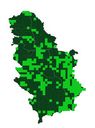
Palearctic: most of Europe (except parts of Spain, southern Italy, United Kingdom), northern Palearctic (Siberia, mountains of South Siberia, Yakutia). Nearctic: North America. P. idas lotis restricted to Mendocino County, California, with historical records in Sonoma and Marin counties.
Seasonality
Single , flies June to August depending on location.
Diet
Larvae feed on Calluna vulgaris, Vaccinium uliginosum, Empetrum nigrum, and various Fabaceae including Cercis siliquastrum, Melilotus albus, Lotus corniculatus, Cytisus, Genista tinctoria, Trifolium pratense, Chrysaspis campestris, Astragalus alpinus, Anthyllis. In northern Upper Rhine Valley, monophagous on Cytisus scoparius.
Host Associations
- Cytisus scoparius - primary larval (some )Monophagous in northern Upper Rhine Valley
- Calluna vulgaris - larval
- Vaccinium uliginosum - larval
- Empetrum nigrum - larval
- Lotus corniculatus - larval
- Trifolium pratense - larval
- Formica pratensis - attendantAttends caterpillars and pupae; northern Upper Rhine Valley
- Formica rufibarbis - attendantAttends caterpillars and pupae; northern Upper Rhine Valley
- Formica cunicularia - attendantAttends caterpillars and pupae; northern Upper Rhine Valley
- Lasius niger - attendantAttends caterpillars and pupae; northern Upper Rhine Valley
- Lasius psammophilus - attendantAttends caterpillars and pupae; northern Upper Rhine Valley
- Lasius spp. - attendantGeneral association
- Formica spp. - attendantGeneral association
Life Cycle
laid on plant stems or debris. Second-stage caterpillars overwinter. Caterpillars attended by ants; also -attended. Single per year.
Behavior
Males patrol to locate plants for females. Caterpillars produce sugar secretions collected by attending ants, which provide protection from natural enemies. in northern Upper Rhine Valley exhibits facultative myrmecophily—diverse partners attend caterpillars without apparent ant-dependence for oviposition—contrasting with obligatorily myrmecophilous Central European populations typically associated with Formica cinerea-group ants.
Ecological Role
Larval herbivore on legumes and ericaceous plants. Participates in mutualistic relationships with ants as caterpillars and pupae. Post-fire increases observed in Sweden, attributed to increased larval plant abundance.
Human Relevance
P. idas lotis (lotis blue ) listed as endangered since 1976, believed extinct since 1994 due to loss from human disturbance affecting vegetation. Subject of conservation concern in Germany where local are highly endangered. Used in research on plant evolution, myrmecophily variation, and fire .
Similar Taxa
- Plebejus argusVery similar appearance; distinguished by presence of hook on male forelegs (absent in P. idas)
- Plebejus argyrognomonVery similar appearance; distinguished by subtle wing pattern differences
Sources and further reading
- BugGuide
- Wikipedia
- GBIF taxonomy match
- iNaturalist taxon
- NCBI Taxonomy
- Matt Forister: Melissa Blue Butterfly and Colonization of Alfalfa | Bug Squad
- Bug Squad
- Hurray for the Red, White and Blue! | Bug Squad
- Blue Butterfly | Bug Squad
- Bug Eric: Mother (Nature's) Day in Madera Canyon
- Facultative myrmecophily in a highly endangered population of Plebejus idas (Linnaeus, 1761) in the northern Upper Rhine Valley (Lepidoptera, Lycaenidae)