
Leptotes cassius
(Cramer, 1775)
Cassius blue, tropical striped blue
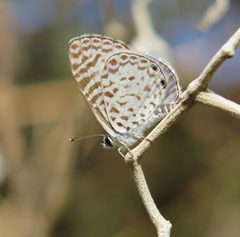
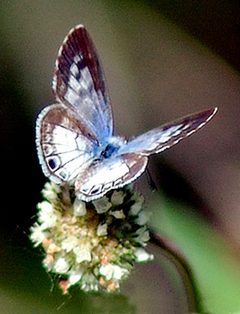
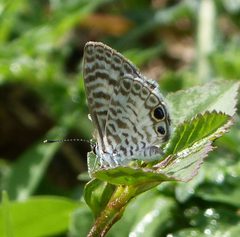
Leptotes cassius is a small, strikingly blue in the Lycaenidae, distributed across the southern United States, Caribbean, Mexico, Central America, and South America. The exhibits facultative myrmecophily, with larvae tended by Camponotus ants, though presence does not significantly influence oviposition decisions. Caterpillars are florivorous, developing inside flower buds of leguminous plants. Multiple are recognized, with L. c. theonus serving as the type species of the Leptotes.
Pronunciation
How to pronounce Leptotes cassius: //lɛpˈtoʊˌtiːz ˈkæs.i.əs//
These audio files are automatically generated. While they are not always 100% accurate, they are a good starting point.
Identification
A tiny blue with wingspan 20–35 mm. The can be distinguished from similar blues by its distribution and association with tropical and subtropical . Specific wing pattern details are not provided in available sources.
Images
Habitat
Tropical and subtropical environments including peninsular Florida, Caribbean islands, and Brazilian cerrado. Associated with open, sunny areas where plants grow.
Distribution
Native to North America in Florida (including the Florida Keys) and Texas, southward through the Caribbean, Mexico, Central America to South America. Strays have been recorded in New Mexico, Kansas, Missouri, South Carolina, North Carolina, and Virginia. L. c. theonus occurs in Florida, Cuba, Bahamas, and Greater Antilles; L. c. cassidula ranges from Texas through Mexico to Panama; L. c. cassius occurs in Suriname and Trinidad & Tobago.
Diet
Larvae are florivorous, feeding on flowers. Documented native plants in the Fabaceae include Amorpha crenulata, Crotalaria incana (woolly rattlepod), Galactia regularis, and Phaseolus lunatus (lima bean). Larvae can also develop on Plumbago auriculata (Cape leadwort) and P. scandens (doctorbush) in the Plumbaginaceae, though these are not closely related to typical hosts.
Host Associations
- Amorpha crenulata - larval Fabaceae
- Crotalaria incana - larval woolly rattlepod, Fabaceae
- Galactia regularis - larval Fabaceae
- Phaseolus lunatus - larval lima bean, Fabaceae
- Plumbago auriculata - larval Cape leadwort, Plumbaginaceae; not closely related to typical Fabaceae
- Plumbago scandens - larval doctorbush, Plumbaginaceae
- Bionia coriacea - oviposition extrafloral nectaried legume shrub in Brazilian cerrado
- Camponotus - mutualistic partnerants tend larvae through active on last body segments; facultative myrmecophily
Life Cycle
are laid on plants. Larvae develop inside flower buds, which may provide protection from natural enemies. Larvae are tended by Camponotus ants through active on their last body segments. presumably occurs within or near host plants, though specific details are not documented in available sources.
Behavior
Exhibits facultative myrmecophily: larvae are tended by Camponotus ants, but presence is not a statistically significant cue for oviposition. Ant attendance involves active on the last body segments of caterpillars. No of immatures was observed regardless of ant presence or absence, suggesting limited protective benefit from ant association in this system.
Ecological Role
As a florivorous herbivore, larvae consume flowers of leguminous plants. The facultative association represents a weak mutualism where ant partners appear to play a minor role in occurrence.
Human Relevance
Featured in Marisha Pessl's 2006 novel Special Topics in Calamity Physics; the protagonist Blue van Meer was named in honor of the Cassius blue.
Similar Taxa
- Leptotes marinaMarine blue, also in Leptotes; similar size and blue coloration but differs in distribution and plant associations
- Hemiargus ceraunusCeraunus blue, similar small blue lycaenid in overlapping range; distinguished by wing pattern and preferences
- Cyclargus ammonOther small blue butterflies in similar ; precise distinguishing features require examination of wing patterns and genitalia
More Details
Subspecies
Six recognized: L. c. cassius (Suriname, Trinidad & Tobago), L. c. catilina, L. c. theonus (Florida, Cuba, Bahamas, Greater Antilles; type of Leptotes), L. c. cassidula (Texas, Mexico, Honduras to Panama), L. c. cassioides (Windward Islands including Dominica), and L. c. striata.
Myrmecophily research
Experimental study in Brazilian cerrado found that while -tended larvae showed tendency for higher abundance, ant presence was not a statistically significant cue for oviposition, and no immatures were parasitized regardless of ant presence, indicating ants play a minor role in this facultatively myrmecophilous system.
Sources and further reading
- BugGuide
- Wikipedia
- GBIF taxonomy match
- iNaturalist taxon
- NCBI Taxonomy
- Catalogue of Life
- Bug Eric: Breaking: Mexican Silverspot Butterfly Sighted in Colorado
- Bug Eric: Mother (Nature's) Day in Madera Canyon
- Bug Eric: September 2010
- Acanthaceae | Beetles In The Bush
- Cassius blue, tropical striped blue Leptotes cassius (Cramer) (Instecta: Lepidoptera: Lycaenidae: Polyommatinae)
- Ant-partners play a minor role on occurrence of the myrmecophilous butterfly Leptotes cassius in its host plant