
Leptotes marina
(Reakirt, 1868)
Marine Blue, Striped Blue
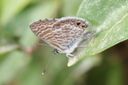
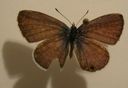
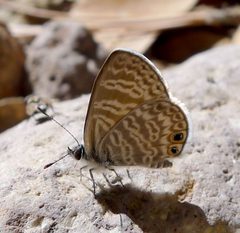
Leptotes marina is a small in the Lycaenidae, commonly known as the Marine Blue or Striped Blue. have a wingspan of 22–29 mm with blue uppersides and brown-banded undersides marked with two blue spots on the hindwings. The occurs from South America through Mexico to the southern United States, with adults active year-round in the south and from April to September in northern . Larvae feed on a diverse range of leguminous plants including Astragalus, Prosopis, and Wisteria.
Pronunciation
How to pronounce Leptotes marina: /lɛpˈtoʊtiːz məˈraɪnə/
These audio files are automatically generated. While they are not always 100% accurate, they are a good starting point.
Identification
Distinguished from similar blues by the combination of small size, blue upperside, and underside pattern of brown bands with two blue spots on the hindwings. The specific epithet 'marina' refers to the striped appearance of the underside, not any marine association.
Images
Appearance
Small with wingspan 22–29 mm. Upperside of wings blue. Underside marked with brown bands and two blue spots on the hindwings.
Habitat
Weedy, open sites and desert environments. Associated with riparian corridors where larval plants occur.
Distribution
South America through Mexico to southern United States (Texas, Arizona, California). Extends northward to southern Canada (Saskatchewan) as a stray. Observed as far north as Colorado Springs, Colorado.
Seasonality
on wing April to September in northern parts of range; year-round in southern portions. Multiple where climate permits.
Diet
Larvae feed on leguminous plants including Astragalus, Amorpha californica, Acacia greggii, Dalea purpurea, Dolichos lablab, Galactia, Glycyrrhiza lepidota, Prosopis glandulosa, Lysiloma thornberi, Lathyrus odoratus, Medicago sativa, Lotus scoparius dendroides, Phaseolus, Wisteria sinensis, and Plumbago. have been observed puddling on wet sand and soil along stream margins to obtain minerals.
Host Associations
- Astragalus - larval foodplant
- Amorpha californica - larval foodplant
- Acacia greggii - larval foodplant
- Dalea purpurea - larval foodplant
- Dolichos lablab - larval foodplant
- Galactia - larval foodplant
- Glycyrrhiza lepidota - larval foodplant
- Prosopis glandulosa - larval foodplant
- Lysiloma thornberi - larval foodplant
- Lathyrus odoratus - larval foodplant
- Medicago sativa - larval foodplant
- Lotus scoparius dendroides - larval foodplant
- Phaseolus - larval foodplant
- Wisteria sinensis - larval foodplant
- Plumbago - larval foodplant
- Amorpha fruticosa - nectar sourceObserved nectaring at flowers in Arizona
Life Cycle
Complete with , larva, pupa, and stages. Larvae have been observed in association with introduced (Iridomyrmex humilis), though the nature of this association requires further study.
Behavior
frequently puddle on wet sand and soil along stream margins, taking up minerals that males transfer to females during mating. Males have been observed defending territories that include larval plants. Adults are relatively approachable when puddling.
Ecological Role
of various flowering plants. Larvae serve as herbivores on leguminous vegetation. Potential prey for .
Human Relevance
Subject of watching and photography. Occasionally encountered in urban and suburban gardens where plants like Wisteria are cultivated. Not considered a pest .
Similar Taxa
- Leptotes cassiusSimilar size and blue coloration; distinguished by differences in underside pattern and spot configuration
- Hemiargus ceraunusOverlapping range and similar use; Ceraunus Blue has different underside pattern with more prominent spots and bands
- Brephidium exileWestern Pygmy-Blue is smaller with more contrasting underside pattern
Misconceptions
The 'Marine Blue' does not indicate any association with marine or coastal ; rather, it derives from the 'marina' epithet referring to the striped (marined) appearance of the wing underside.
More Details
Ant Association
Larvae have been documented in association with the introduced Argentine ant (Iridomyrmex humilis), though the ecological nature of this relationship remains unclear.
Northern Range Extension
Documented as far north as Colorado Springs, Colorado in April 2017, representing a significant northern record for the .
Puddling Behavior
frequently observed in at wet sand and mud along stream margins, particularly important for male mineral acquisition prior to mating.