
Lycaena epixanthe
(Boisduval & Le Conte, 1835)
bog copper, cranberry-bog copper
Lycaena epixanthe, commonly known as the bog or cranberry-bog copper, is the smallest North American copper . It is to acid bogs and exhibits extreme specialization, spending its entire life within a single bog. The has a with under water. Listed as a species of special concern in Connecticut, it conservation challenges due to habitat loss.
Pronunciation
How to pronounce Lycaena epixanthe: //laɪˈsiːnə ˌɛpɪkˈsænθi//
These audio files are automatically generated. While they are not always 100% accurate, they are a good starting point.
Identification
Distinguished from similar coppers by its small size and restriction to acid bogs. Purplish copper (Lycaena helloides) is larger with more orange on female upper side and conspicuous orange submarginal line on hind wing in both sexes. Dorcas copper (Lycaena dorcas) is larger with more black spots on male upper side, more orange on female upper side, and pinkish-brown or tan underside with red-orange hind wing submarginal line.
Images
Appearance
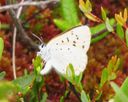
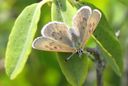
Wingspan 2.2–2.5 cm. Upper side of male wings dark gray-brown with strong purplish sheen that glows intensely under UV light; few black basal spots on forewing; orange markings on hind wing outer margin. Female upper side similar but with lighter purplish iridescence. Underside of wings in both sexes varies from whitish-gray to yellowish-tan.
Habitat
Acid bogs with cranberries (Vaccinium ). Occupies specialized peatland with acid soil conditions.
Distribution
North America; recorded from Vermont and other northeastern US states, with range extending through Canada.
Seasonality
Late June to early August; timing varies regionally (mid-June to mid-July near Ottawa, mid-June to early July in New Jersey, mid-June to mid-August in Maine).
Diet
Larvae feed exclusively on shrubby cranberries: Large cranberry (Vaccinium macrocarpon) and Small cranberry (Vaccinium oxycoccos). sip dew drops and nectar almost exclusively from cranberry flowers.
Host Associations
- Vaccinium macrocarpon - primary larval Large cranberry
- Vaccinium oxycoccos - primary larval Small cranberry
Life Cycle
(one per year). overwinters, usually under water with fully developed larva inside; egg can withstand flooding. Larva bluish-green with darker green stripe. Chrysalis pale yellow-green to green with brown and white markings, rarely solid dark purple. Approximately 85% of lifespan spent in egg stage.
Behavior
Males perch on low cranberry foliage from 10:00 A.M. to 6:00 P.M. to await females. Upon detecting a female, males pursue; after female lands, male lands behind her, vibrates wings, and mating ensues. If female has mated or rejects mating, she vibrates wings and male departs. Females lay singly on underside of plant leaves a few inches above bog surface. weak and close to ground; difficult to capture due to bog .
Ecological Role
Specialized herbivore dependent on cranberry plants in peatland . Serves as for intact acid bog .
Human Relevance
Listed as of special concern in Connecticut. Conservation focus for acid bog preservation.
Similar Taxa
- Lycaena helloideslarger size; female has extensive orange on upper side; both sexes have conspicuous orange submarginal line on hind wing upper side
- Lycaena dorcaslarger size; male has more black spots on upper side; female has more orange on upper side; underside pinkish-brown or tan with red-orange hind wing submarginal line
- Lycaena heteroneablue color on upper side and brown on underside (reversed from L. epixanthe)
Sources and further reading
- BugGuide
- Wikipedia
- GBIF taxonomy match
- Mary Louise Flint's Article in The Acorn: 'Butterflies in Decline' | Bug Squad
- 'Climate Change' May Be a Key Factor in Declining Butterfly Populations | Bug Squad
- Over a century later, the mystery of the Alfred Wallace’s butterfly is solved | Blog
- Grassland butterflies: important indicators of the state of nature
- Life history and morphology of the immature stages of the bog copper butterfly Lycaena epixanthe (Bsd. & LeC.) (Lepidoptera: Lycaenidae)
- Flight morphology corresponds to both surrounding landscape structure and local patch conditions in a highly specialized peatland butterfly ( Lycaena epixanthe )