
Lycaena heteronea
Boisduval, 1852
blue copper
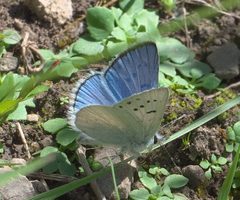
Lycaena heteronea, the blue , is a North American in the Lycaenidae. Males display bright sky-blue upper wing surfaces with dark , while females are copper-brown with black dots. The is tightly associated with Eriogonum (buckwheat) plants and occupies a range of open in western North America from British Columbia to New Mexico. It is single-brooded with seasons varying geographically from April through August.
Pronunciation
How to pronounce Lycaena heteronea: /lɪˈsiːnə ˌhɛtəˈroʊniə/
These audio files are automatically generated. While they are not always 100% accurate, they are a good starting point.
Identification
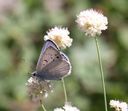
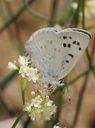
Males distinguished from Boisduval's blue (Icaricia icarioides) by brighter sky-blue coloration and specific wing pattern details. Females recognized by -brown upper wings with black dots versus blue in males of similar . Underside pattern of white/off-white with brown-black forewing dots consistent across sexes.
Images
Habitat
Open including brushy areas, mountain meadows, open forests, and sagebrush. In California, restricted to flat areas of Kern and Los Angeles counties, canyon areas near Lebec and O'Neil Canyon, and oak-associated sites. Elevation range: typically 1208–1651 m, though 917–1452 m in central California. Presence contingent on quality of Eriogonum plants.
Distribution
Western North America: southern British Columbia and Alberta in Canada; Washington, California, Colorado, and New Mexico in the United States. California localized and restricted.
Seasonality
season April to August, varying by region: British Columbia April–July; Alberta July–August. Single-brooded .
Diet
Larvae feed primarily on three Eriogonum (buckwheat) , eating leaf undersides when young, entire leaves when older. feed on diverse nectar sources including buckwheat, green rabbitbrush (Chrysothamnus viscidiflorus), asters, yarrow, gaillardia, fiddleneck, wallflower, and milkweed.
Host Associations
- Eriogonum - larval plantprimary ; three used
- Eriogonum fasciculatum - larval plantused at Frazier Park, California
- Formica francoeuri - mutualismfacultative myrmecophily; larvae observed in association with this in California
Life Cycle
Single-brooded. laid singly on plant bracts, modified leaves, or undersides; hatch following spring. Larvae pass through four instars before pupating. emerge, with males seeking mates and females seeking host plants for oviposition.
Behavior
Males patrol and perch on Eriogonum flower , defending territories aggressively against males using visual detection. Territorial defense ignores other , including superficially similar ones. Females focus on locating high-quality plants for -laying. Males display wing coloration to females during courtship; females prefer males with superior coloration. capable of up to one kilometer; no migratory documented.
Ecological Role
of diverse flowering plants. Larval herbivore on Eriogonum. Facultative mutualism with Formica francoeuri ants provides potential protection benefits to larvae.
Human Relevance
Subject of long-term monitoring studies. for grassland and open health. Conservation status ranked G5 globally (abundant and secure) but T2 in southern California (vulnerable to extirpation). Threatened by fire frequency increase in California habitats.
Similar Taxa
- Icaricia icarioides (Boisduval's blue)Males frequently confused with L. heteronea males; distinguished by differences in blue color intensity and wing pattern details
More Details
Conservation status
Nature Conservancy Global Rank G5 (abundant and secure globally); T2 in southern California (scarcity makes it vulnerable to extirpation). declines in California linked to increased fire frequency destroying open forest .
Climate sensitivity
Documented in regional studies of western North American decline associated with warming and drying trends, though L. heteronea not individually highlighted in published analyses.
Sources and further reading
- BugGuide
- Wikipedia
- GBIF taxonomy match
- Catalogue of Life
- Mary Louise Flint's Article in The Acorn: 'Butterflies in Decline' | Bug Squad
- 'Climate Change' May Be a Key Factor in Declining Butterfly Populations | Bug Squad
- Over a century later, the mystery of the Alfred Wallace’s butterfly is solved | Blog
- Grassland butterflies: important indicators of the state of nature