
Lycaena phlaeas
(Linnaeus, 1761)
small copper, American copper, common copper
Lycaena phlaeas is a holarctic in the Lycaenidae, commonly known as the small or American copper. It is widespread across Europe, Asia, North America, and North Africa. The is notable for its bright orange forewings with dark borders and black spots. It has been identified as a species that shows to degradation, with in Germany demonstrating a positive trend in the Grassland Butterfly Index despite overall declines in grassland butterfly populations.
Pronunciation
How to pronounce Lycaena phlaeas: //laɪˈsiːnə ˈfleɪ.əs//
These audio files are automatically generated. While they are not always 100% accurate, they are a good starting point.
Identification
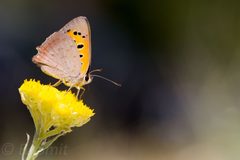
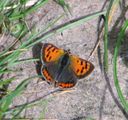
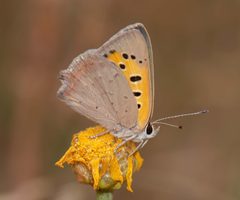
Distinguished from similar copper butterflies by the combination of bright orange forewings with dark borders and multiple black spots, and dark hindwings with orange margins. The presence of blue spots in some females (form caeruleopunctata) is distinctive. Underside pattern of grey-brown hindwings with small black dots separates it from related . The small is more widespread and -tolerant than specialized grassland butterflies such as the small blue (Cupido minimus) or dingy skipper (Erynnis tages).
Images
Habitat
Occurs in diverse including chalk downlands, heathland, woodland clearings, churchyards, and urban waste ground. Shows broad habitat compared to specialized grassland .
Distribution
Holarctic distribution: widespread across Europe, Asia, North America, and North Africa south to Ethiopia. Present throughout south and central England and Wales; distribution becomes patchier in northern England, Scotland, and Ireland.
Seasonality
Most active in bright sun. Two to three per year, fewer in northern areas. In favorable years, a fourth brood may occur in southern regions with flying into November. Overwinters as a caterpillar.
Diet
Larval plants primarily common sorrel (Rumex acetosa) and sheep's sorrel (Rumex acetosella); other Rumex occasionally used. feed on nectar.
Host Associations
- Rumex acetosa - larval plantcommon sorrel
- Rumex acetosella - larval plantsheep's sorrel
Life Cycle
laid singly and conspicuously on upperside of food plant leaves. Young caterpillar feeds on underside of leaf, creating 'windows' by leaving upper untouched. occurs in leaf litter; pupa is thought to be tended by ants. Overwinters as caterpillar. Two to three annually in most of range, fewer in north; occasional fourth brood in south during exceptional years.
Behavior
Males establish and vigorously defend small territories against rival males and passing insects; even shadows of large birds overhead can elicit defensive responses. Females are pursued by males and mating typically occurs in vegetation. Most active in bright sunlight.
Ecological Role
Serves as a in stage. Larval feeding on Rumex may contribute to plant . -tended pupae suggest mutualistic relationships with ants. As a species with stable or increasing in some regions, it contributes to in degraded agricultural landscapes.
Human Relevance
Used as an for the EU Grassland Index, which monitors biodiversity in agricultural landscapes. In Germany, it is one of four increasing among 15 grassland butterfly indicator species, demonstrating to degradation compared to specialized species. Popular subject for butterfly watchers and photographers due to bright coloration and widespread occurrence.
Similar Taxa
- Cupido minimusBoth occur in grassland ; small distinguished by larger size, bright orange coloration, and broader habitat . Small blue is declining in Germany while small copper shows positive trend.
- Erynnis tagesBoth grassland butterflies; small distinguished by bright orange coloration versus dingy skipper's dull brown appearance. Dingy skipper is declining in Germany while small copper is stable or increasing.
- Lycaena disparBoth copper butterflies; small distinguished by smaller size, more widespread distribution, and lack of large copper's specialization.
More Details
Etymology
Specific epithet phlaeas derived either from Greek phlégo ('to burn up') or Latin floreo ('to flourish'), referencing the bright orange coloration.
Subspecies
Numerous described across range, including L. p. phlaeas (Europe, type locality Sweden), L. p. americana (eastern North America), L. p. hibernica (Ireland), and others; taxonomic validity of some subspecies questioned.