
Lycaena dorcas
Kirby, 1837
dorcas copper, cinquefoil copper
Species Guides
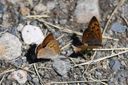
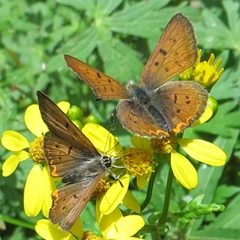
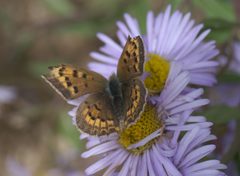
6Lycaena dorcas is a small native to North America, first described by William Kirby in 1837. It is commonly known as the dorcas or cinquefoil copper. The exhibits in coloration and has a single period between June and September. It inhabits bogs and old overgrown fields across a broad northern range extending from Alaska to the Great Lakes region.
Pronunciation
How to pronounce Lycaena dorcas: //lɪˈsiːnə ˈdɔrkəs//
These audio files are automatically generated. While they are not always 100% accurate, they are a good starting point.
Identification
Males resemble Lycaena helloides in coloration; distinguished by red-orange hindwing marginal spots and slight orange tint. Females lack the strong iridescence of males and show patchy lighter areas. The isolated Maine may require additional verification.
Images
Appearance
Small with wingspan 2.5–3.2 cm. surface brown; males display blue-purple iridescence, females have lighter patchy areas. Hindwings bear red-orange marginal spots on both sexes. surface brown with slight orange tint. Caterpillar pale green with single dark green dorsal line and faint white bands.
Habitat
Occupies bogs and old overgrown fields. Associated with larval plants in wet or successional .
Distribution
North America: Alaska south to Washington in the west; Great Lakes region in the east. Isolated in Maine.
Seasonality
Single period June through September. active during summer months.
Host Associations
- Potentilla fruticosa - larval plant
- Rumex - larval plant unspecified
- Polygonum - larval plant unspecified
Life Cycle
with one per year. Females deposit white singly on undersides of plant leaves. Eggs fall with leaves in autumn and overwinter. Caterpillars emerge in spring and return to host plants to feed.
Behavior
Males remain near plants to locate females. Oviposition occurs on leaf undersides.
Similar Taxa
- Lycaena helloidesMale coloration similar; distinguished by red-orange hindwing marginal spots and orange tint in L. dorcas
More Details
Taxonomic history
L. dospassosi was formerly treated as with L. dorcas but has been separated as a distinct .
Sources and further reading
- BugGuide
- Wikipedia
- GBIF taxonomy match
- Catalogue of Life
- Mary Louise Flint's Article in The Acorn: 'Butterflies in Decline' | Bug Squad
- 'Climate Change' May Be a Key Factor in Declining Butterfly Populations | Bug Squad
- Over a century later, the mystery of the Alfred Wallace’s butterfly is solved | Blog
- Grassland butterflies: important indicators of the state of nature