
Lycaena dospassosi
McDunnough, 1940
maritime copper, saltmarsh copper
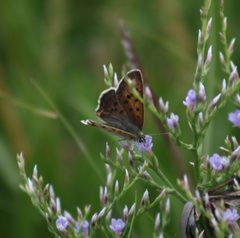
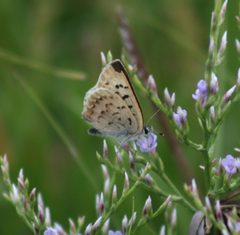
Lycaena dospassosi is a small copper to eastern Canada, restricted to coastal saltmarsh where its larval foodplant Argentina egedei grows. First described in 1940 by James McDunnough, it was originally treated as a of L. dorcas but is now recognized as a valid . The butterfly has a wingspan of 25–31 mm and flies from late July to mid-August. nectar on sea lavender (Limonium carolinianum).
Pronunciation
How to pronounce Lycaena dospassosi: //lɪˈsiːnə ˌdɔsˈpɑːsoʊsi//
These audio files are automatically generated. While they are not always 100% accurate, they are a good starting point.
Images
Appearance
Wingspan 25–31 mm. Males: duller purple above than L. dorcas, with noticeably larger black spots on both upper and undersides of wings. Underside of forewing pale yellowish-buff; hindwing underside browner with yellow submarginal band of crescent-shaped markings. Females: similar to males but forewing upperside brown with partial yellow band beyond postmedial row of black spots.
Habitat
Coastal saltmarsh meadows where larval foodplant Argentina egedei (silverweed) grows.
Distribution
to eastern Canada: eastern Quebec and the Maritime Provinces (New Brunswick, Nova Scotia, Prince Edward Island), occurring along Gulf of St. Lawrence coasts.
Seasonality
period late July to mid-August.
Diet
Larvae feed exclusively on silverweed (Argentina egedei). nectar on sea lavender (Limonium carolinianum).
Host Associations
- Argentina egedei - larval foodplantalso known as silverweed
- Limonium carolinianum - nectar sourcealso known as sea lavender
Similar Taxa
- Lycaena dorcasL. dospassosi was originally described as a of L. dorcas; distinguished by larger wingspan, duller purple coloration in males, and larger black spots on wings.
More Details
Taxonomic history
Originally described as Lacaena dorcas var. dospassosi in 1940, later elevated to status. Sometimes placed in Tharsalea or in subgenus Epidemia of Lycaena.
Etymology
Specific epithet honors American lepidopterist Cyril Franklin dos Passos.
Population status
Has localized distribution but may occur in large numbers at suitable sites.
Sources and further reading
- BugGuide
- Wikipedia
- GBIF taxonomy match
- Catalogue of Life
- Mary Louise Flint's Article in The Acorn: 'Butterflies in Decline' | Bug Squad
- 'Climate Change' May Be a Key Factor in Declining Butterfly Populations | Bug Squad
- Over a century later, the mystery of the Alfred Wallace’s butterfly is solved | Blog
- Grassland butterflies: important indicators of the state of nature