
Erynnis juvenalis clitus
W.H. Edwards, 1883
Clitus Duskywing
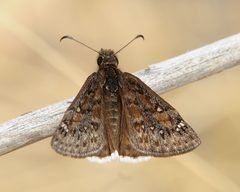
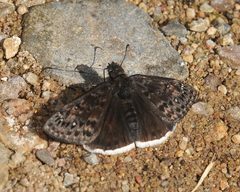
Erynnis juvenalis clitus is a of the Juvenal's Duskywing skipper, a small brown in the Hesperiidae. It is distributed across central and eastern North America, with records from Canada through the United States. The subspecies is active in early spring, with flying from April through May. It is one of several difficult-to-distinguish duskywing skippers in the Erynnis.
Pronunciation
How to pronounce Erynnis juvenalis clitus: /ˈɛrɪnɪs juːvɛnˈælɪs ˈklaɪtəs/
These audio files are automatically generated. While they are not always 100% accurate, they are a good starting point.
Identification
Difficult to distinguish from Horace's Duskywing (Erynnis horatius) based on appearance alone. E. juvenalis can be reliably separated by the presence of one or two white dots on the hindwing, which E. horatius lacks. Additionally, E. juvenalis flies only in early spring (April–May), while E. horatius continues through summer. Examination of the ventral wing surface or timing is required for confident identification.
Images
Appearance
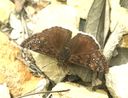
Small to medium-sized skipper with dark brown to blackish wings. Forewings may show small pale spots. hindwing has one or two small white dots, a diagnostic feature separating E. juvenalis from the similar E. horatius, which lacks these dots. Body is robust and hairy, typical of skippers. have hooked tips.
Habitat
Open including prairies, glades, fens, and woodland edges. Has been observed in calcareous wet meadows and riparian woodlands.
Distribution
North America: recorded from Manitoba and Saskatchewan in Canada; Vermont and southward in the United States; Middle America. Distribution overlaps with but extends beyond the nominate E. j. juvenalis.
Seasonality
fly in early spring, primarily April through May. Single-brooded; does not persist through summer like E. horatius.
Behavior
are rapid, darting fliers typical of skippers. Perch on low vegetation and bare ground. Males may be territorial.
Ecological Role
may visit flowers for nectar; potential . Larval plants are oaks (Quercus spp.), making this part of the oak woodland .
Human Relevance
Subject of citizen science observations through platforms like iNaturalist. Interest to lepidopterists due to identification challenges with similar .
Similar Taxa
- Erynnis horatiusNearly identical appearance; distinguished by lack of hindwing dots and summer period
- Erynnis juvenalis juvenalisNominate with overlapping range; subtle differences in distribution and possibly wing pattern
More Details
Taxonomic status
Erynnis juvenalis clitus is currently treated as a synonym of Erynnis juvenalis by some sources, though iNaturalist and GBIF maintain it as a valid . The subspecific distinction may reflect geographic variation rather than reproductively isolated .
Identification challenges
Field identification to level is generally not possible without specimen examination. Photographic records often remain at or level due to similarity among Erynnis .