
Pholisora mejicanus
(Reakirt, 1866)
Mexican Sootywing
Pholisora mejicanus, commonly known as the Mexican Sootywing, is a in the Hesperiidae. It is distributed from the southwestern United States through most of Mexico, occupying open including disturbed roadsides, railways, and mountainous gulches. The exhibits rapid, darting typical of skippers and can be distinguished from similar Pholisora species by the blue-gray underside of its hindwings with contrasting black .
Pronunciation
How to pronounce Pholisora mejicanus: //ˌfoʊ.lɪˈsɔː.rə ˌmɛ.hɪˈkɑː.nəs//
These audio files are automatically generated. While they are not always 100% accurate, they are a good starting point.
Identification
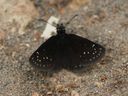
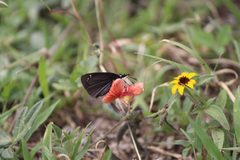
In the field, Pholisora mejicanus appears as a black skipper with white dots arranged in a specific pattern on the upperside of the wings. The most reliable distinguishing feature from other Pholisora is the blue-gray coloration on the underside of the hindwing with prominent contrasting black ; this trait is more diagnostic than the dot pattern. The are distinctively hooked or recurved at the tips, a characteristic of the Hesperiidae .
Images
Habitat
Open areas including disturbed roadsides, railways, mountainous gulches, and canyons.
Distribution
In the United States, restricted to the eastern foothills of the Rocky Mountains from southern Colorado southward. In Mexico, occurs from the southern border of western Texas south through highlands into Oaxaca state in southern Mexico.
Diet
Caterpillars feed on amaranths (Amaranthaceae) and Chenopodium .
Host Associations
- Amaranthaceae - larval foodplantamaranths
- Chenopodium - larval foodplantgoosefoots
Behavior
Exhibits rapid, darting typical of skippers. Rests with wings held at different angles, unlike which rest with wings spread flat and unlike most butterflies which fold wings directly above the body.
Similar Taxa
- Pholisora catullus (Common Sootywing)Overlaps extensively in distribution and resembles P. mejicanus in appearance; however, the two rarely occur together at the same locality in New Mexico, and genetic studies confirm they have remained independent species throughout their evolutionary history.
More Details
Species status
Despite occurring in the same general area as Pholisora catullus and having larvae that can feed on the same plants, genetic studies confirm P. mejicanus and P. catullus have remained independent for a long evolutionary period and do not interbreed where they co-occur.
Nomenclature note
The specific epithet 'mejicanus' uses the older spelling 'Mejico' for Mexico; the is also referred to as 'Mexican sootywing' in common usage.