
Megathymus streckeri
(Skinner, 1895)
Strecker's giant skipper, Strecker's Giant-Skipper
Megathymus streckeri is a large in the Hesperiidae, commonly known as Strecker's giant skipper. It is to the central and western United States, where it inhabits arid grassland and rocky environments. The is notable for its relatively large size among skippers and its obligate association with yucca plants as larval .
Pronunciation
How to pronounce Megathymus streckeri: /mɛˈɡæθɪməs ˈstrɛkəri/
These audio files are automatically generated. While they are not always 100% accurate, they are a good starting point.
Identification
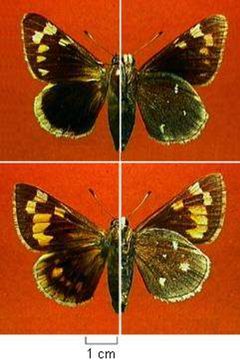
Distinguished from other Megathymus by geographic range and plant associations. The large size (wingspan exceeding 55 mm) separates it from most other North American skippers except related giant skippers. Dark wings with pale yellow markings are characteristic; similar species in the occur in different regions or have slightly different spot patterns. The is rapid and powerful, with often perching on or near yucca plants.
Images
Habitat
Shortgrass prairies, sand hills, rocky bluffs, and arid grasslands. Strongly associated with yucca-dominated vegetation . Elevational range extends from plains to moderate elevations in rocky terrain.
Distribution
United States: southeastern Montana and southwestern North Dakota south to southern Texas, west to northwestern Arizona and southwestern Utah. The occupies the central and southern Great Plains and adjacent intermountain regions.
Diet
Larvae feed internally in the stems and roots of yucca plants: Yucca glauca, Yucca constricta, Yucca angustissima, and Yucca baileyi. feeding habits are not documented in available sources.
Host Associations
- Yucca glauca - larval soapweed yucca
- Yucca constricta - larval Buckley's yucca
- Yucca angustissima - larval narrowleaf yucca
- Yucca baileyi - larval Bailey's yucca
Life Cycle
Larvae are stem-borers in yucca, feeding internally on living tissue. The is incompletely documented but has been inferred to extend over multiple years based on observations of related in the Megathymus. occurs within the yucca stem or root. are active during the warmer months, though specific is not well recorded.
Behavior
have a rapid, direct typical of large skippers. They are often observed flying low among yucca plants or perching on vegetation. Larval is cryptic, with stem-boring habits keeping them concealed within tissue.
Ecological Role
As a yucca- herbivore, the larvae may influence yucca growth and , though specific impacts have not been quantified. The contributes to the specialized fauna of yucca-dominated in arid North American grasslands.
Human Relevance
Occasional subject of interest for collectors and observers. No significant economic or conservation status has been documented. The is not known to be of agricultural concern.
Similar Taxa
- Megathymus yuccaeOverlaps in range and use; distinguished by subtle differences in wing pattern and male genitalia
- Megathymus cofaquiSoutheastern relative with different geographic distribution and plant associations
More Details
Taxonomic note
Originally described as Aegiale streckeri by Skinner in 1895, later transferred to Megathymus. The specific epithet honors John Kern Strecker, an American naturalist.
Conservation
No formal conservation status has been assigned; trends are poorly documented.