
Lerodea
Scudder, 1872
Species Guides
2- Lerodea arabus(Violet-clouded Skipper)
- Lerodea eufala(Eufala Skipper)
Lerodea is a of grass skippers in the Hesperiidae, comprising seven described distributed primarily in the Americas. The genus was established by Scudder in 1872, with Lerodea eufala designated as the type species. Species in this genus are generally associated with grassland and open , where their larvae feed on various grass species. The most widely distributed member, Lerodea eufala (the Eufala Skipper), ranges from the southern United States through much of South America.
Pronunciation
How to pronounce Lerodea: //lɛˈroʊdiə//
These audio files are automatically generated. While they are not always 100% accurate, they are a good starting point.
Identification
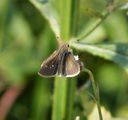
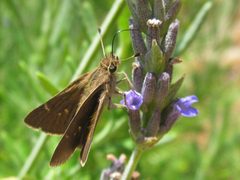
Lerodea are small to medium-sized skippers with relatively nondescript brown or grayish-brown wings. The Violet-clouded Skipper (Lerodea arabus) can be distinguished by a distinct dark brown patch on the underside of the hind wing. Members of this lack the bright coloration seen in many other skipper groups and typically do not show prominent wing markings. Accurate species identification often requires examination of wing pattern details and, in some cases, genitalia.
Images
Habitat
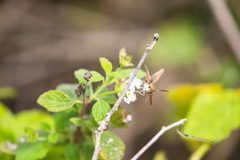
Grasslands, open fields, agricultural areas, and disturbed where grasses are present. The Tucson Gardens observation of Lerodea arabus occurred in a cultivated garden setting with maintained plantings.
Distribution
New World distribution ranging from the southern United States (Arizona, Texas, and southeastern states) through Mexico, Central America, and into South America. Individual have more restricted ranges within this general pattern.
Seasonality
activity varies by and latitude. In the southwestern United States, Lerodea arabus has been observed in early spring (March). Lerodea eufala is known to have multiple per year in warmer regions, with adults present across extended periods.
Diet
Larvae feed on grasses (Poaceae). Lerodea arabus caterpillars have been documented feeding on Bermuda grass (Cynodon dactylon), barnyard grass (Echinochloa spp.), and other weedy grass .
Host Associations
- Cynodon dactylon - larval food plantBermuda grass; documented for Lerodea arabus
- Echinochloa - larval food plantBarnyard grass; documented for Lerodea arabus
Life Cycle
Complete with , larva, pupa, and stages. Larvae are grass-feeders. Specific details on sites and stages vary by and are not well documented for most members of the .
Ecological Role
Larvae function as primary consumers in grassland . may contribute to pollination while nectaring, though this has not been quantified.
Human Relevance
Lerodea eufala is considered a potential pest of sugarcane in some regions. The association of several with weedy grasses means they are occasionally found in agricultural and suburban environments.
Similar Taxa
- Eufala Skipper (Lerodea eufala)Most frequently encountered ; other Lerodea may be overlooked due to superficial similarity
- Other Hesperiinae skippersMany grass skippers share similar brown coloration and preferences; precise identification requires attention to subtle wing pattern differences
Misconceptions
The "Violet-clouded Skipper" for Lerodea arabus is misleading, as no violet coloration is visible on the wings; the appears uniformly brown or grayish-brown.
More Details
Taxonomic history
The was established by Samuel Hubbard Scudder in 1872. Lerodea sonex was described as recently as 2022 by Grishin, indicating ongoing taxonomic work in this group.
Rarity perceptions
Despite feeding on common weedy grasses, Lerodea arabus is frequently listed as "rare" in reference works. This may reflect undercollection rather than true rarity, or may indicate specific requirements not fully understood.