
Lerodea eufala
(Edwards, 1869)
Eufala Skipper, Rice Leaffolder
Lerodea eufala, commonly known as the Eufala Skipper or Rice Leaffolder, is a small grass-feeding in the Hesperiidae. It is widely distributed across the Americas, from the southeastern United States through Mexico and Central America to Patagonia, with seasonal northward range expansion during summer months. The is notable for its association with agricultural and weedy grasses, including cultivated sorghum and sugarcane, and maintains multiple per year in warm climates.
Pronunciation
How to pronounce Lerodea eufala: /lɛˈroʊdiə juːˈfɑːlə/
These audio files are automatically generated. While they are not always 100% accurate, they are a good starting point.
Identification
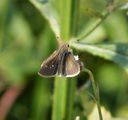
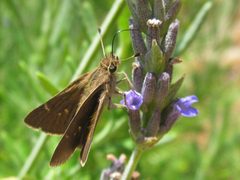
Distinguished from similar skippers by its relatively plain, uniformly colored wings lacking bold spots or strong patterning. The Fiery Skipper (Hylephila phyleus) shows more distinct spotting and brighter orange coloration. The Violet-clouded Skipper (Lerodea arabus) can be separated by the dark brown patch on the underside of the hindwing, which L. eufala lacks. The Eufala Skipper's association with grassland and agricultural , combined with its subdued coloration, aids field identification.
Images
Habitat
Open grasslands, agricultural fields, pastures, roadsides, and other disturbed areas with abundant grasses. Readily colonizes anthropogenic including rice fields and sugarcane plantations.
Distribution
Resident from coastal Georgia south through Florida and west across the southern United States to southern California. Range extends south through Mexico and Central America to Patagonia. Seasonal summer expansion reaches north to central California, North Dakota, southern Wisconsin, northern Michigan, and Washington, D.C.
Seasonality
Two per year in the deep south with active February to October. Multiple overlapping generations throughout the year in Florida, southern Texas, and Arizona. Northern range expansion occurs during summer months.
Diet
Larvae feed on various grasses including Sorghum halepense (Johnson grass), Cynodon dactylon (Bermuda grass), and Saccharum officinarum (sugarcane). feed on nectar from flowers including croton, alfalfa, composites, and lippia.
Host Associations
- Sorghum halepense - larval food plantJohnson grass
- Cynodon dactylon - larval food plantBermuda grass
- Saccharum officinarum - larval food plantsugarcane
- Croton - nectar source
- Medicago sativa - nectar sourcealfalfa
- Asteraceae - nectar sourcecomposites
- Lippia - nectar source
Life Cycle
Complete with , larva, pupa, and stages. Two annually in most of range; continuous breeding with multiple overlapping generations in subtropical and tropical regions.
Ecological Role
of herbaceous flowers during stage. Larval stage functions as primary consumer of grasses, with potential economic impact as a pest in rice and sugarcane .
Human Relevance
Considered an agricultural pest in rice and sugarcane production, with 'rice leaffolder' reflecting damage caused by larval feeding. Subject of observation and photography, with over 13,000 documented observations on citizen science platforms.
Similar Taxa
- Hylephila phyleusFiery Skipper has brighter orange coloration and more distinct wing spotting patterns
- Lerodea arabusViolet-clouded Skipper possesses a distinct dark brown patch on the underside of the hindwing that L. eufala lacks; also considered rarer despite similar
More Details
Subspecies
Two recognized : Lerodea eufala eufala (widespread), and Lerodea eufala concepcionis restricted to Chile.